Author name: EuroWindoor

EuroWindoor feedback on EU-CDW-EoW-Survey (August 2023)

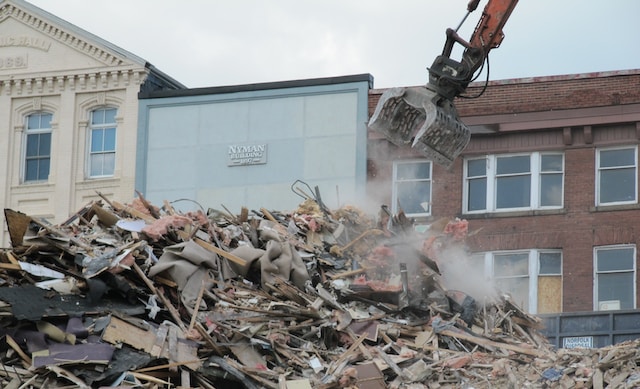
The European Commission is considering to establish European end-ofwaste
criteria for construction and demolition waste. To develop a
priority list of construction and demolition waste streams for which endof-
waste criteria can be established, we would like to get your feedback
in your field of expertise. In general, more information about a waste
stream will allow us to create more precise and practical priority lists.
End-of-waste criteria are all the requirements that have to be fulfilled by a material derived
from waste, and which ensure that the quality of the material is such that that material will not
be discarded and its use is not detrimental for human health and the environment. The
concept of end-of-waste criteria implies that the waste material has reached a stage of
processing whereby it has an intrinsic value, so it is unlikely to be discarded and has been
processed to a point at which its use does not represent a risk to the environment.

EuroWindoor feedback on EU-CDW-EoW-Survey (August 2023)

EuroWindoor feedback on EU-CDW-EoW-Survey (August 2023) Read More »

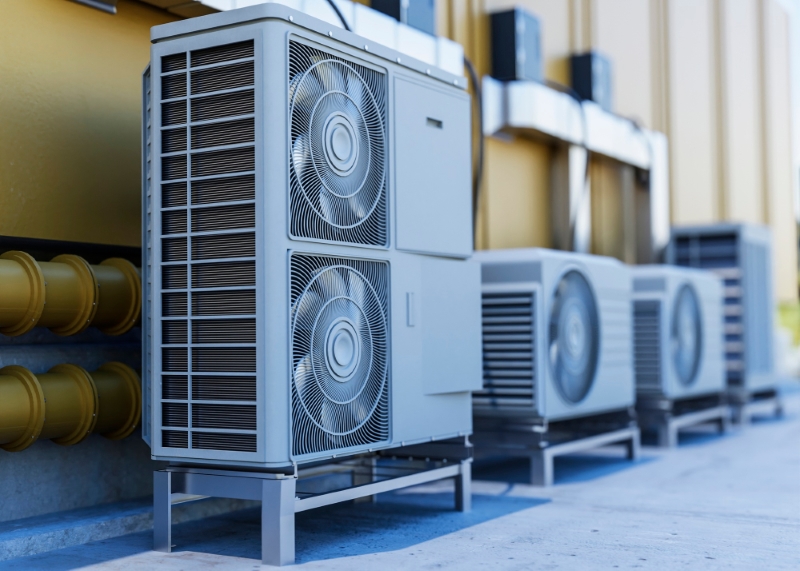
EuroWindoor answer to Public Consultation on Heat pumps – action plan to accelerate roll-out across the EU (August 2023)

Introduction
Rolling out heat pumps is central to the clean-energy transition and to achieving carbon neutrality in line
with the goals set in the European Green Deal. All policy scenarios underpinning the ‘Fit for 55’ legislative
proposals show a significant uptake of heat pumps in all sectors, and notably in buildings. To meet the
2030 targets and deliver the needed fast decarbonisation of heat, installing boilers in new buildings and
replacing fossil-fuel boilers by newer ones should be discontinued as soon as possible.
The REPowerEU plan calls for prioritising investments in renewables and energy efficiency to reduce fossilfuel
imports and for doubling current roll-out rates of heat pumps in buildings. It also calls for a faster rollout
of large heat pumps for district heating and cooling networks.
There is an urgent need to shift to renewable and efficient heating and cooling technologies in buildings,
industry and networks. The European Commission report on the competitiveness of clean energy
technologies indicates that the roll-out of all types of heat pumps needs to accelerate further: from heat
pumps for single-family houses, large multi-apartment buildings, tertiary buildings and heat networks, to
high-temperature heat pumps for industrial applications. The Green Deal Industrial Plan points to heat
pumps as one of the key technologies to meet EU climate-neutrality goals in the Net-Zero Industry Act to
underpin industrial manufacturing.

EuroWindoor answer to Public Consultation on Heat pumps – action plan to accelerate roll-out across the EU (August 2023)

EuroWindoor answer to Public Consultation on Heat pumps – action plan to accelerate roll-out across the EU (August 2023) Read More »

EuroWindoor looks back on a busy first half of 2023

Frankfurt, 11. August 2023 – EuroWindoor reflects on a productive and dynamic first half of 2023 marked by extensive engagements. EuroWindoor has been significantly involved in the work of the CPR Technical Acquis for windows and doors as well as the development of the revision of EPBD and renewal of the approval of Propiconazole.

EuroWindoor helped in the CPR Technical Acquis process to clarify definitions and essential characteristics for future harmonised product standards of windows and doors. Another important topic was the feedback to the new product priorities under the Ecodesign for Sustainable Products Regulation (ESPR) where EuroWindoor underlined the importance to accelerate data availability throughout the value chains. EuroWindoor assisted ECHA and the Standing Committee for Biocidal Products with technical background and studies for the use of Propiconazole. A special highlight was a European Window Stakeholder meeting with the European Commission DG Energy explaining the concerns of the window sector on the development of Green Public Procurement, Taxonomy and the Energy Performance of Buildings Directive.

EuroWindoor operates within a dynamic framework that succeeds on the engagement of its members to prepare meaningful input for European authorities. The members meet in the Directing Council on regular basis to exchange opinions and for the decision-making but the main work is done in several ad hoc groups composed of experts from different countries. This year, experts met so far 10 times in the ad hoc groups “Energy,” “Digital Data/BIM,” and “CPR” to prepare proposals for adoption of the EuroWindoor members. In addition, EuroWindoor collaborates with other European Window Stakeholder to promote dialogue and knowledge exchange within the sector.

For more information on the EuroWindoor positions click here.

Press Contact:
Miriam Weppler
EuroWindoor General Secretariat
Walter-Kolb-Str. 1-7
60594 Frankfurt / Germany
Phone: +49 (69) 95 50 54 – 36
Fax: +49 (69) 95 50 54 – 11
Email: GS@EuroWindoor.eu

EuroWindoor looks back on a busy first half of 2023 Read More »

an exemption for cadmium and lead in plastic profiles in electrical and electronic windows and doors

EuroWindoor feedback on the draft RoHS Exemption for PVC windows and doors (July 2023)

Feedback to the Public Consultation on draft RoHS Exemption for the use of PVC recycling material with cd and/or pb in windows and doors with electrical functions

EuroWindoor appreciates the opportunity to give feedback to the draft Delegated Directive amending RoHS Directive 2011/65/EU as regards an exemption for cadmium and lead in plastic profiles in electrical and electronic windows and doors containing recovered rigid polyvinyl chloride (U-PVC).

EuroWindoor highly supports the Delegated Directive as it aligns the requirements of RoHS with the Commission Regulation (EU) 2023/923 amending Annex XVII to REACH to comply with the circular economy targets. This is also supported by EuroWindoor in order to harmonize the overlap between different European legislations as long as complete construction products are included in the scope of RoHS. But there is an important difference in the draft delegated Act regarding the period of validity compared to the REACH derogation. While the expiry date in REACH is set to 28 May 2033 the derogation in RoHS will end on 28 May 2028.

EuroWindoor feedback on the draft RoHS Exemption for PVC windows and doors (July 2023)

EuroWindoor feedback on the draft RoHS Exemption for PVC windows and doors (July 2023) Read More »

EuroWindoor advocates for alignment and clarification in the RoHS exemption for PVC windows and doors

Frankfurt, July 2023 – EuroWindoor, the European association of windows, doors and facade manufacturers, welcomes the draft delegated directive enabling the use of recovered post-consumer rigid PVC in plastic profiles of electrical and electronic windows and doors. EuroWindoor commends the efforts to harmonize European legislations but emphasizes the need for alignment and clarification to facilitate a smoother regulatory process.

The proposed Delegated Directive aims to align RoHS requirements with the REACH regulation, the latter covering chemical substances in the EU. EuroWindoor supports this alignment to minimize conflicts between overlapping European legislations, ensuring a more streamlined regulatory landscape. But a critical issue arises from the differing validity periods outlined in the draft Delegated Directive compared to the REACH derogation. While the REACH derogation is set to expire in May 2033, RoHS expiry date is set to May 2028. EuroWindoor strongly recommends to take care about possible conflicts in future and to ensure that there will be a renewal of the exemption in 2028 to keep RoHS aligned with REACH as long as a new decision will follow the Commission review in 5 years.

Moreover, EuroWindoor highlights the issue of double regulations for construction products, such as windows and doors, which have to comply with the Construction Products Regulation (CPR) and REACH with similar targets like RoHS. EuroWindoor proposes a focused approach by limiting the scope of RoHS to the electrical device of the window/door. To achieve this, EuroWindoor suggests different options for the Commission to proceed. Such a limited scope would resolve conflicting regulations and make the Delegated Directive with the exemption redundant.

The EuroWindoor feedback on the draft RoHS exemption for PVC windows and doors is available here.
For more information on RoHS and the impact on the window sector click here.

Press Contact:
Miriam Weppler
EuroWindoor General Secretariat
Walter-Kolb-Str. 1-7
60594 Frankfurt / Germany
Phone: +49 (69) 95 50 54 – 36
Fax: +49 (69) 95 50 54 – 11
Email: GS@EuroWindoor.eu

EuroWindoor advocates for alignment and clarification in the RoHS exemption for PVC windows and doors Read More »

EuroWindoor reminds the Commission to the ‘Energy Efficiency First’ principle regarding the action plan for heat pumps

Frankfurt, June 2023 – EuroWindoor did ask for a balanced approach between efficiency of building envelope and use of renewable energy when giving its feedback to the consultation on the action plan to accelerate roll-out of heat pumps across the EU. The use of high-performance windows does reduce energy demand and allows heating by less power-consuming heat pumps in a cost-optimal way preventing from electrical power shortage.

The cheapest energy is the one we don’t use. This saying is especially true for the building stock in the EU as it uses around 40% of the energy and is responsible for around 36% of greenhouse gas emissions. Decarbonisation of heating is an important factor and EuroWindoor welcomes the initiative for the use of more renewable energies.

However, EuroWindoor reminds the Commission of the Energy Efficiency First principle. The buildings need to be viewed as an energy system. Therefore an action plan should remain open to technology und focusing on a balanced approach that generates low energy demand and use of renewables in equal measures to make decarbonisation a success.

The EuroWindoor feedback on the action plan for heat pumps is available here.
For more information on why to #startwiththewindow click here.

Press Contact:
Miriam Weppler
EuroWindoor General Secretariat
Walter-Kolb-Str. 1-7
60594 Frankfurt / Germany
Phone: +49 (69) 95 50 54 – 36
Fax: +49 (69) 95 50 54 – 11
Email: GS@EuroWindoor.eu

EuroWindoor reminds the Commission to the ‘Energy Efficiency First’ principle regarding the action plan for heat pumps Read More »

EuroWindoor feedback to the Call for Evidence on heat pumps

EuroWindoor feedback to Call for Evidence on heat pumps (May 2023)

EuroWindoor acknowledges that heat pumps are an important part of the energy transition in the building sector but they are not the solution for everything. Heat pumps are not an option for many existing buildings and the building sector needs a balanced approach between efficiency of building envelope and use of renewable energy. A specialized technology initiative for the heat pump is therefore not beneficial.

The cheapest energy is that unused and buildings should be seen as part of the energy system and not as isolated islands (in line with the ‘Energy Efficiency First’ principle). Good insulation of the opaque building envelope and the use of high-performance windows reduce energy consumption and related CO2 emissions from buildings. In future industry and transport sector will significantly need more electricity from renewable sources in order to achieve decarbonization targets. Improving the building envelope will decrease energy demand and electrical power shortage. The remaining energy demand is low and can be provided efficiently over a long period of time with cheaper and less power-consuming heat pumps in a cost-optimal way.

EuroWindoor feedback to Call for Evidence on heat pumps (May 2023)

EuroWindoor feedback to Call for Evidence on heat pumps (May 2023) Read More »

Start with the Window to make the Renovation Wave a success

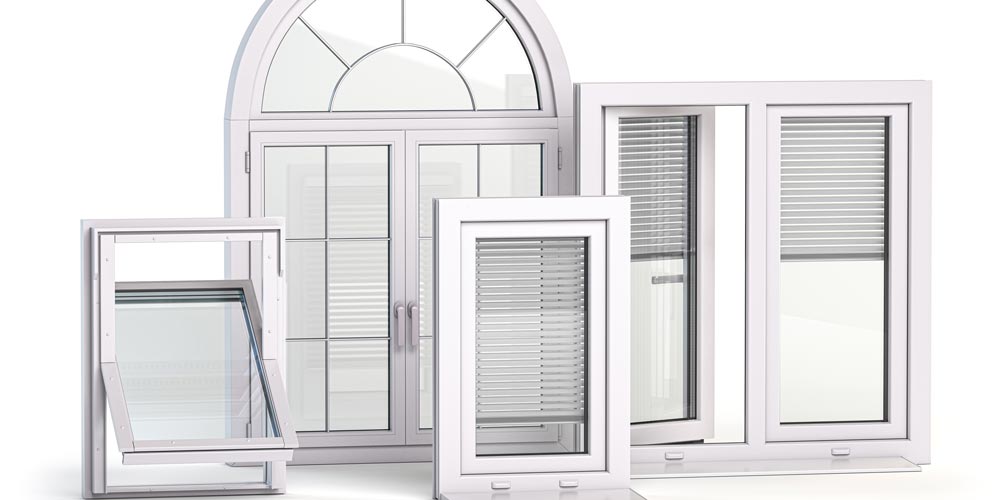
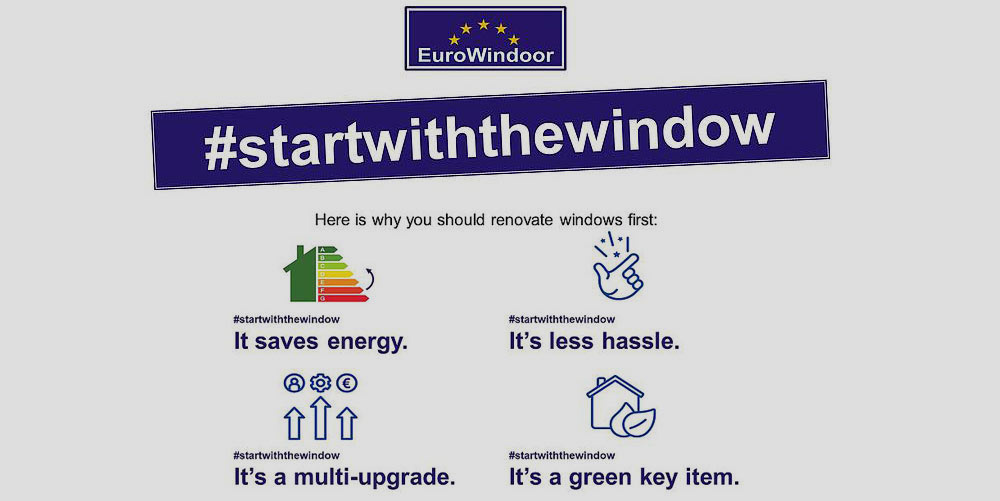
Brussel, May 2023 – The Renovation Wave is in full swing to tackle the issues of rising emissions and energy poverty. The aim is to double the renovation rate in order to save energy in buildings. Windows are a key part for the success of the Renovation Wave. To remind homeowners and politicians EuroWindoor has summarized the most important reasons to #startwiththewindow.

#startwiththewindow – It saves energy.

There aren’t many construction products which improved this much in the last decades: Modern windows are 2-3x more energy efficient than windows pre 1995. This is why new windows raise the Efficiency Rating of a building. And amortise through saved heating cost within a few years

#startwiththewindow – It’s less hassle.

Changing a window with modern minimal invasive methods is done quickly. It often even does not necessarily need bricklayers, scaffolders, painters but only one trade: window installers. They can replace windows without dirt, noise and damage of the existing building structure and anyone to move out. And they install at plannable costs at a fraction of the conventional installation effort.

#startwiththewindow – It’s a multi-upgrade.

Additional to lower energy consumption new windows can bring a lot of significant benefits that raise every buildings value, e.g. they can reduce noise, profit from solar gains, keep the temperature comfortable, optimize ventilation, improve burglar resistance, allow better accessibility and are an aesthetic update.

#startwiththewindow – It’s a green key item.

New windows provide significant upgrade for every building with limited material input. Window manufacturers in Europe work steadily to improve new windows’ recyclability and CO2 footprint. Therefore, window replacements set forward for a decarbonization of EU buildings and industry.

You can download the One Pager #startwiththewindow here.

Press Contact:
Miriam Weppler
EuroWindoor General Secretariat
Walter-Kolb-Str. 1-7
60594 Frankfurt / Germany
Phone: +49 (69) 95 50 54 – 36
Fax: +49 (69) 95 50 54 – 11
Email: GS@EuroWindoor.eu

Start with the Window to make the Renovation Wave a success Read More »

Public consultation on new product priorities under the Ecodesign for Sustainable Products Regulation (ESPR)

EuroWindoor answer to the public consultation on new product priorities for ESPR (May 2023)

Introduction

1.1 Background to this consultation

A proposal for a Regulation on Ecodesign for Sustainable Products (ESPR) was adopted by the Commission in March 2022. The ESPR is a framework for setting ecodesign requirements on products to improve their circularity, energy performance and other environmental sustainability aspects. While the ESPR proposal provides a general framework for setting rules, the actual product requirements will be adopted only in a second stage. The Commission should therefore adopt and regularly update a working plan, setting out product priorities for which ecodesign requirements should be laid down.

The purpose of this questionnaire is to gather your views on what the new product priorities under the ESPR should be.

EuroWindoor answer to the public consultation on new product priorities for ESPR (May 2023)

EuroWindoor answer to the public consultation on new product priorities for ESPR (May 2023) Read More »

Ecodesign for Sustainable Products Regulation

EuroWindoor feedback to Call for Evidence on new product priorities for ESPR (May 2023)

EuroWindoor welcomes the Commission’s recent proposal on new product priorities under the Ecodesign for Sustainable Products Regulation (ESPR) and appreciates the opportunity to
provide input to which categories of new products and measures to address first and to promote that the EU Commission can set priorities transparently and inclusively.

EuroWindoor general position is outlined here (Call for Evidence) and specific input is given in the questionnaire of the Public Consultation which is open in parallel.
EuroWindoor supports the overall effort to ensure fair and equal conditions for products placed on the European market. This includes a harmonised way to assess, declare, market and verify environmental sustainability and circularity parameters. EuroWindoor strongly supports applying the approach used in EN 15804 as the baseline for construction products.

EuroWindoor feedback to Call for Evidence on new product priorities for ESPR (May 2023)

EuroWindoor feedback to Call for Evidence on new product priorities for ESPR (May 2023) Read More »

EuroWindoor welcomes EPBD adoption in European Parliament

Frankfurt, 14 March 2023 – We need an ambitious revision of the Energy Performance of Buildings Directive (EPBD) to enable the green transition of the European building stock and create more sustainable and healthier living conditions for all Europeans. EuroWindoor therefore welcomes the adoption of the European Parliament report on the EPBD today.

The text adopted in plenary contains significant improvements to the European Commission proposal. European window, door and facade manufacturers now call on the EU Institutions to start the trilogue negotiations without any further delay.

The European Parliament position provides a clear and realistic roadmap, both for building owners and industry to accelerate the annual renovation rate across Europe. EuroWindoor particularly supports the new provisions put forward by the Parliament to introduce a more holistic approach to buildings, moving beyond energy performance requirements to address all building parameters, so also environment and health.

Specifically, the European Parliament managed to strengthen the Commission proposal as regards:

  • better factoring in health and comfort with a new article on Indoor Environmental Quality (IEQ) and new definitions (healthy indoor climate, indoor environmental quality);
  • strengthened definition of zero-emission buildings;
  • greater recognition of Energy Efficiency First principle, benefits of passive building systems and the overall role of the building envelope for the energy performance of buildings;
  • faster roll-out of Mandatory Energy Performance Standards (MEPS) and harmonisation of Energy Performance Certificates (EPCs) to trigger the renovation of worst performing buildings; and
  • more ambitious and faster roll-out of whole life carbon thresholds in new buildings.

Unfortunately, the text adopted by the Parliament still does not consider the relevance of the energy balance approach, failing to include the g-value for transparent elements of the building envelope in the Energy Performance Certificates (ANNEX V). In addition, while we welcome the new provisions on IEQ, more specific methodologies for IEQ parameters are needed, especially as regards daylight, IAQ and overheating. The necessary introduction of LCA requirements for new buildings will strongly influence the future building design for the decades to come. So it will be critical that while improving the energy performance and cutting CO2 emissions in buildings, health aspects are tackled at the same time. Otherwise, there is a risk to repeat the same mistake as with nZEB buildings where energy design was strengthened, often at the expense of daylight and overheating mitigation. It is time for a more holistic approach, factoring in all relevant building parameters.

The European Parliament position represents a strong basis for the upcoming trilogue negotiations and we call on all EU institutions to ensure an ambitious outcome. The current EPBD does not sufficiently factor in IEQ parameters, so the new provisions put forward by the European Parliament must be reflected in the final legislation. Without the right legislative framework, Europe will not be able to transform its building stock into one which is energy efficient, decarbonised but also healthy. The European window, door and facade manufacturers are ready to help deliver.

Press Contact:
Miriam Weppler
EuroWindoor General Secretariat
Walter-Kolb-Str. 1-7
60594 Frankfurt / Germany
Phone: +49 (69) 95 50 54 – 36
Fax: +49 (69) 95 50 54 – 11
Email: GS@EuroWindoor.eu

EuroWindoor welcomes EPBD adoption in European Parliament Read More »

Criteria for Curtain Walling in the EU Taxonomy Climate Delegated Act (February 2023)

In the DRAFT COMMISSION NOTICE from 19th December 2022 with FAQs addressing the interpretation and implementation of certain legal provisions of the EU Taxonomy Climate Delegated Act, the Question 40 replies to the possibility for curtain walling to qualify for taxonomyalignment under Section 3.5.

According to the given answer, Curtain Walling will fall under the windows criteria with U-value ≤ 1.0 W/(m²K) if at least 80% of the surface is glazed and transparent. If the glazed and transparent area is less when some opaque panels are included, the criteria for wall systems will apply with U-value ≤ 0.5 W/(m²K).

As Curtain Walling fulfils rarely at least 80% of glazed and transparent surface and U values usually are higher than 0.50 W/(m²K) the FAQ 40 does not solve the problem that the product cannot comply with the EU Taxonomy.

Differentiating the criteria for Curtain Walling to fall into either the category of windows or walls does not seem to take fully into account the characteristics of Curtain Walling and does not give a fair evaluation. Curtain Walling is rarely composed in a way that can be compared with a simple wall.

The nature of Curtain Walling is indeed that can be used to create diversity in the façade with the variety of transparent and opaque areas. This gives a large flexibility in the architecture of the façade as well as the use of the rooms inside the building. This ensures good energy performance combined with the admittance of solar gain, daylight and view.

In the Annex are some examples from recent projects in Denmark, Norway and UK made of high performing products showing the diversity of Curtain Walling, however also showing that the suggested distinction between transparent and opaque areas is not reasonable and thus the criteria for Curtain Walling should be linked to Windows only, and without conditions. This is also a simple approach.

We also would like to remind to the Joint call to revise criteria for windows in the EU Taxonomy Climate Delegated Act (October 2022) which is also valid for the situation of Curtain Walling. The setting of a pan European maximum U-value for Windows and Curtain Walling does not serve the climate and the environment, because it does not allow to factor in geographical and climatic differences to optimise resource and energy use. It rather promotes highly insulated windows and curtain walls everywhere in the EU irrespective of the climatic conditions.

In the medium term the EU Taxonomy criteria should be revised to also factor in the ‘Energy balance’ approach for transparent products like Windows and Curtain Walling by replacing the present pan-European maximum U-value by values for Heating energy demand and/or Cooling energy demand according to different climatic conditions.

Joint position on Criteria for Curtain Walling in the EU Taxonomy Climate Delegated Act (February 2023)

Criteria for Curtain Walling in the EU Taxonomy Climate Delegated Act (February 2023) Read More »

Newsletter 12/2022

Overview on EuroWindoor’s activities

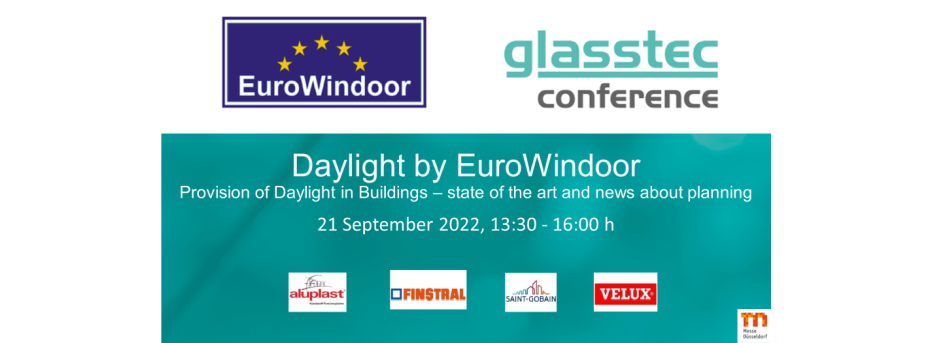
1. EuroWindoor welcomes to the conference “Daylight by EuroWindoor” on the 21st September 2022 at the glasstec in Dusseldorf
2. EuroWindoor looks back to a successful conference “Daylight by EuroWindoor” at glasstec 2022
3. EuroWindoor advocates ambitious Minimum Energy Performance Standards (MEPS) in the EPBD
4. EuroWindoor demands to revise criteria for transparent products in EU Taxonomy Climate Delegated Act
5. EU Commission Construction Unit dives deeply into windows manufacturing
6. EuroWindoor and the EU Commission Construction Unit continue to meet about new CPR and the Technical Acquis process for windows and doors
7. EuroWindoor welcomes the Panhellenic Federation of Craftsmen in Aluminium and Metal Constructions (POVAS) as new member
8. EuroWindoor wishes joyful holidays and remembers the year 2022
9. Appointments 2023

More information

Newsletter 12/2022 Read More »

EuroWindoor wishes joyful holidays and remembers the year 2022

Frankfurt, December 2022 – Soon 2022 will come to an end, so EuroWindoor would like to take the chance and review the year. It was a challenging year with many important topics like the proposal to recast the EPBD, revision of REACH and RoHS, the recast of the CPR and much more.
The beginning of the year was over shadowed by the lasting impacts of the pandemic and even more from the war of aggression by Russia against the Ukraine. Despite this burden the European Union stayed faithful to their plan on becoming the first emission neutral continent by 2050. EuroWindoor is happy to have been able to give input on important consultations and having several meetings with representatives of the European Commission.

A highlight in 2022 was the successful conference “Daylight by EuroWindoor” at the glasstec in Dusseldorf. EuroWindoor was able to show with well-known experts the importance of daylight in buildings.

In addition, EuroWindoor got approached by the DG Joint Research Center to help the members of the JRC buildings team in getting a better understanding of the products in the window industry.

There are many more important and exciting topics that EuroWindoor already tackled in 2022 like the derogation to the exclusion criteria for Propiconazole or the proposal to recast the EPBD.
With all of these challenges still on going and new proposals coming 2023 will be surely as challenging and successful as 2022.

EuroWindoor wishes everyone happy Holidays and a happy New Year!
We hope that this holiday season brings you enormous happiness and peace in your life.

For more information, please see the following sites:

EuroWindoor position papers

Conference “Daylight by EuroWindoor” at glasstec and streams

Press Contact:
Miriam Weppler
EuroWindoor General Secretariat
Walter-Kolb-Str. 1-7
60594 Frankfurt / Germany
Phone: +49 (69) 95 50 54 – 36
Fax: +49 (69) 95 50 54 – 11
Email: GS@EuroWindoor.eu

EuroWindoor wishes joyful holidays and remembers the year 2022 Read More »

EuroWindoor welcomes the Panhellenic Federation of Craftsmen in Aluminium and Metal Constructions (POVAS) as new member

Brussels, December 2022 – POVAS becomes a new member association of EuroWindoor at the beginning of 2023. The federation is a second level trade organization in Greece and represents 26 professional organisations in the field of aluminium and iron constructions as well as of aluminium and iron manufacturing. Overall POVAS stands for a sector in Greece with approximately 6.000 enterprises and about 25.000 workers.

EuroWindoor appreciates POVAS as another member representing window, door and facade manufacturers strengthening EuroWindoor in its mission of contributing to the EU’s commitment regarding better regulation as well as job creation, energy security, resource efficiency and carbon emission reductions without imposing unnecessary burdens on the sector. With POVAS EuroWindoor counts now 20 member associations and 1 company member from 15 European countries.

For more information about the members please visit the EuroWindoor website

Press Contact:
Miriam Weppler
EuroWindoor General Secretariat
Walter-Kolb-Str. 1-7
60594 Frankfurt / Germany
Phone: +49 (69) 95 50 54 – 36
Fax: +49 (69) 95 50 54 – 11
Email: GS@EuroWindoor.eu

EuroWindoor welcomes the Panhellenic Federation of Craftsmen in Aluminium and Metal Constructions (POVAS) as new member Read More »

EuroWindoor and the EU Commission Construction Unit continue to meet about new CPR and the Technical Acquis process for windows and doors

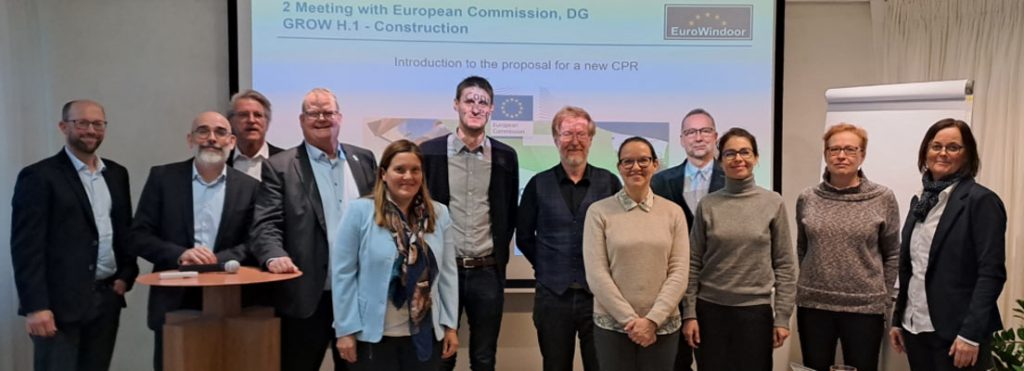
Brussels, December 2022 – Two members of the European Commission DG GROW Unit H.1 for Construction joined the EuroWindoor Directing Council meeting on 23rd November to follow up the discussion about the challenges window and door manufacturer are faced by the proposed new Construction Production Regulation (CPR).

At the beginning Mr Manfred Fuchs, Policy Senior Assistant of DG GROW H.1 and responsible for the CPR Technical Acquis process of the subgroup on product area “Doors, Windows, Shutters, Gates and related Building Hardware” was available to discuss EuroWindoor members questions about the development of a new mandate for the future product standards. Soon the dialogue focused on the Commission proposal for a new CPR and the concern of the window and door sector that broadening of the scope leads to over-regulation and additional administrative burden.

Policy Officer Oscar Nieto addressed the concerns for a new CPR in a presentation and answered questions in the discussion. During the meeting the complexity of transparent products were underlined and how this will be dealt in the new CPR and the future Declaration of Performance (DoP). Additional topics were around the timetable for the CPR, questions around the Annexes, the use of digital databases and more.

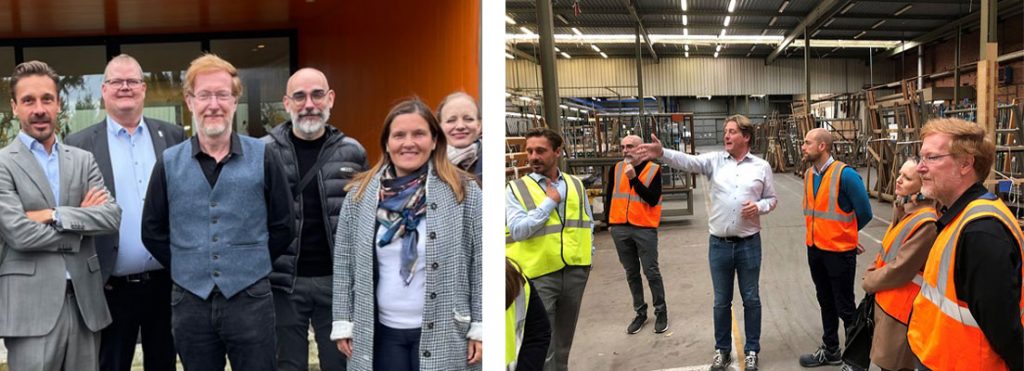
The meeting with DG GROW H.1 came along with a factory tour EuroWindoor organized one week before giving the Commission a deep insight to the complex window and door manufacturing process. EuroWindoor would like to thank Mr Fuchs and Mr Nieto for taking their time and their willingness to consider the concerns of the fenestration sector.

Press Contact:
Miriam Weppler
EuroWindoor General Secretariat
Walter-Kolb-Str. 1-7
60594 Frankfurt / Germany
Phone: +49 (69) 95 50 54 – 36
Fax: +49 (69) 95 50 54 – 11
Email: GS@EuroWindoor.eu

EuroWindoor and the EU Commission Construction Unit continue to meet about new CPR and the Technical Acquis process for windows and doors Read More »

EU Commission Construction Unit dives deeply into windows manufacturing

Brussels, November 2022 – EuroWindoor organised on request of the European Commission DG GROW H.1 for construction a visit to manufacturing plants of Engels Ramen en Deuren for timber and Avista Aluminium for aluminium windows and doors.

The factory tour of the Commissions officers for Construction Products Regulation and Sustainable construction was motivated by the current revision of the regulation. EuroWindoor President Verena Oberrauch and Secretary General Frank Koos presented together with the company owners Didier and Christophe Engels a program demonstrating the complexity and variety of windows and their manufacturing.

The day ended successfully in a Q&A session with an intense discussion about the needs of the fenestration sector concerning the new CPR and the CPR Acquis process. EuroWindoor thanks the participants from the European Commission for their deep interest in windows and the family Engels for opening their manufacturing plants to facilitate a mutual understanding of the challenges window manufacturers have.

Press Contact:
Miriam Weppler
EuroWindoor General Secretariat
Walter-Kolb-Str. 1-7
60594 Frankfurt / Germany
Phone: +49 (69) 95 50 54 – 36
Fax: +49 (69) 95 50 54 – 11
Email: GS@EuroWindoor.eu

EU Commission Construction Unit dives deeply into windows manufacturing Read More »

EuroWindoor demands to revise criteria for transparent products in EU Taxonomy Climate Delegated Act

Frankfurt, November 2022 – EuroWindoor published together with European Aluminium and EPPA a joint position to bring attention to the short comings of the Taxonomy Climate Delegated Act. Amendments are needed to use the full potential of windows, doors and curtain walls.
EuroWindoor favours the taxonomy as it strengthened green investments by defining criteria for them. The products windows, doors and curtain walling contribute to a strong improvement of energy efficiency and therefore, climate protection in the building sector.

Unfortunately, by setting a pan-European maximum thermal transmittance value (U≤1,0 W/m²K) the present criteria for windows does not allow to factor in geographical and climatic differences to optimise resource and energy efficiency by tasking solar gains into account. As a consequence, the EU Taxonomy criteria needs to be revised to use the ‘Energy balance’ approach for transparent products like windows and curtain walling. In addition, curtain walling should have similar requirements as ‘windows’ since they have a large proportion of glazed area and thermally behaviour like windows.

For further information please see:

Joint call to revise criteria for windows in the EU Taxonomy Climate Delegated Act

Press Contact:
Miriam Weppler
EuroWindoor General Secretariat
Walter-Kolb-Str. 1-7
60594 Frankfurt / Germany
Phone: +49 (69) 95 50 54 – 36
Fax: +49 (69) 95 50 54 – 11
Email: GS@EuroWindoor.eu

EuroWindoor demands to revise criteria for transparent products in EU Taxonomy Climate Delegated Act Read More »

EuroWindoor advocates ambitious Minimum Energy Performance Standards (MEPS) in the EPBD

Frankfurt, October 2022 – EuroWindoor demands to preserve the ambitious nature of the revision of the Energy Performance of Buildings Directive (EPBD) as political parties try to deflate it by deleting important instruments as MEPS that help trigger the Renovation Wave to make the building stock more energy efficient.

The war in the Ukraine has shown how dependent many European countries are on oil and gas. Therefore, it is especially important now to trigger renovations and have the European building stock become more energy efficient to prevent from energy poverty, dependency and to reduce emissions. This can only be done if the legislators have strong instruments at their disposal to boost renovations.

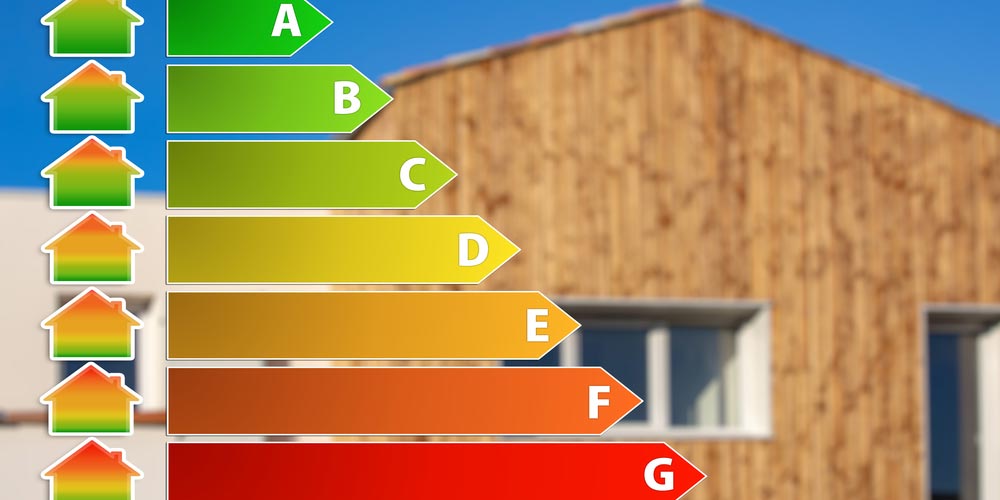
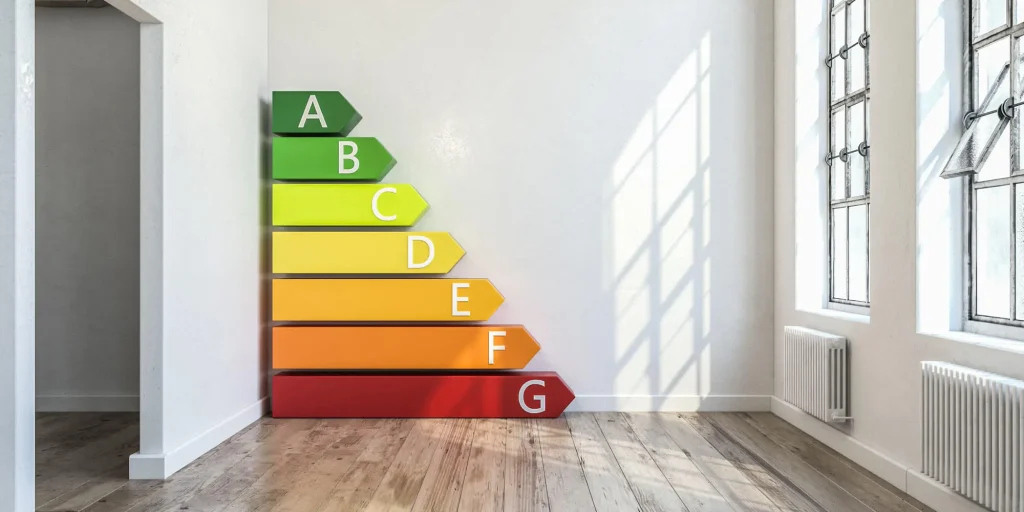
Currently the EPBD is being revised, the main legislative tool aiming to promote the improvement of the energy performance of buildings. One of the most important proposed instruments are the MEPS (Minimum Energy Performance Standards). The MEPS categorize the building stock in energy performance classes ranging from G, representing 15% of the worst performing buildings, to A, comparable to zero-emission buildings. The aim is to renovate the worst classes by a certain time frame starting from G to the at least next best energy class. For example every public owned building in energy performance class G shall be renovated by 2027 and by 2030 those of energy performance class F. This approach guarantees that the Renovation Wave gets implemented and that the EU is able to achieve its ambitious goal of becoming climate neutral by 2050.

EuroWindoor has been in contact with other industry groups to support the ambitious goals set in the original revised version of the EPBD and to prevent a softening of the EPBD that would stop a Renovation Wave from happening.

For further information please see:

Joint position on ambitious MEPS – A no regret option (October 2022)

Joint position on Staying the Course to deliver the Renovation Wave (October 2022)

Press Contact:
Miriam Weppler
EuroWindoor General Secretariat
Walter-Kolb-Str. 1-7
60594 Frankfurt / Germany
Phone: +49 (69) 95 50 54 – 36
Fax: +49 (69) 95 50 54 – 11
Email: GS@EuroWindoor.eu

EuroWindoor advocates ambitious Minimum Energy Performance Standards (MEPS) in the EPBD Read More »

Call on EU policy makers to revise criteria for windows in EU Taxonomy Climate Delegated Act

Call on EU policy makers to revise criteria for windows in EU Taxonomy Climate Delegated Act (October 2022)

Introduction

In June 2021, the EU Taxonomy Climate Delegated Act was published in the EU Official Journal.

Unfortunately, by setting a pan-European maximum thermal transmittance value (U≤1,0 W/m2K) the present criteria for windows does not allow to factor in geographical and climatic differences to optimise resource and energy use. It rather promotes highly insulated windows everywhere in the EU irrespective of the climatic conditions.

This problem will be particularly important in hot climatic conditions and in several cases for moderate climate too.

This paper provides a short explanation and references to demonstrate why this is the case.

Finally, as the Delegated Act does not clearly state which criteria are applicable to curtain walling, this paper explains why they should be considered as similar to windows.

Why setting a pan European maximum U-value for windows does not serve the climate and the environment?

To see the impact of a window on climate change during the heating season, the heating demand or heat gain that it is causing must be calculated. The thermal transmittance of the window named ‘U-value’ alone is not giving that information.

To have that information, the U-value must be multiplied by a value reflecting the difference between indoor and outdoor temperature across the heating season, the so-called ‘heating degree hours’. This value depends on climatic conditions that vary a lot across the EU: it is 5 times higher in cold climate than in hot climate.

Then, the energy gains thanks to solar irradiation passing through the window must also be considered since this is renewable and free energy. To calculate it, the solar factor of the window, named ‘g-value’, must be considered. The g-value is the percentage of solar irradiation that a window allows entering into the building. So, multiplied by solar irradiation, it gives the solar heat gains. Solar irradiation depends on local climate condition and orientation.

Combining the heat losses and solar heat gains, i.e. making an “energy balance” gives the correct picture of the energy performance of windows and shows that windows are positive contributors to building envelopes as a source of renewable energy.

Joint call to revise criteria for windows in the EU Taxonomy Climate Delegated Act

Call on EU policy makers to revise criteria for windows in EU Taxonomy Climate Delegated Act (October 2022) Read More »

Ambitious Minimum Energy Performance Standards: A no regret option

Ambitious Minimum Energy Performance Standards: A no regret option (October 2022)

The twin geopolitical and energy crises have thrown into sharp relief the high combined costs of Europe’s energy dependency and poor building energy performance. Buildings account for 40% of our energy consumption, most of which is used to keep us warm1 and energy renovations are the only
solution to durably shelter citizens and businesses from price hikes.

Financial incentives for renovations must be backed by effective regulations. Solely relying on voluntary schemes has not worked so far, with only 1% of EU buildings undergoing energy renovations each year, and an annual rate of deep renovations only 0.2% in the EU.

Leading industry players, NGOs, think tanks and investors are thus calling Members of the European Parliament to adopt ambitious Minimum Energy Performance Standards (MEPS) in the EPBD recast. MEPS are the main tool addressing the pressing issues of energy poverty, energy security and decarbonisation in the revised text and are critical for both planning purposes and for execution.

What does ‘ambitious MEPS’ mean in practice?
When it comes to timelines and benchmarks, MEPS should bring public and non-residential
buildings EPC class F and G to EPC class C by 2030 and residential buildings EPC class F and G to EPC
class C by 2033.

This level of ambition should be linked to financial and technical support – such as social safeguards – for low-income households and guarantees on rent.

Minimum Energy Performance Standards should also be based on the following guiding principles:

• MEPS should cover the whole building stock starting first with the worst-performing buildings
• MEPS should be based on firm benchmarks and timelines to reach a sufficient decarbonisation contribution by 2030, 2040, and towards full decarbonisation by 2050
• MEPS’ first benchmark should go beyond the energy class E benchmark and make buildings ready for the efficient integration of renewable energy sources (low temperature heating/renewable
cooling/Solar thermal and PV)
• Only relying on trigger points such as sale, rent or donation is not sufficient to achieve Europe’s 2050 climate objectives. To achieve the objectives of the Renovation Wave, MEPS should apply trigger points together with a progressive trajectory for renovations towards a fully decarbonised
building stock in 2050
• Provisions on MEPS should be complemented by a strong governance and enabling instruments to ensure implementation and consequences for failing to reach the targets
• The success of MEPS is linked to the roll out and improvement of other tools discussed in the EPBD: Energy Performance Certificates, One Stop Shops and Building Renovation Passports

Ambitious MEPS will benefit citizens and businesses alike

Ambitious MEPS are good for people: High energy prices are putting an increasing financial burden on the poorest European households – homeowners and renters alike. Adopting ambitious MEPS the most sustainable long-term solution to permanently shelter citizens from energy price hikes while providing much needed co-benefits such as improved indoor environment.

Ambitious MEPS are necessary to achieve energy security: Translated into impact on Russian imports, the research group Guidehouse estimates that going to B/C class would cut gas imports by about 45%, versus only 13% by going to E class.

Ambitious MEPS are good for the construction sector and job creations: MEPS provide much needed medium- and long-term market visibility. Together with a strong supportive framework that addresses the challenges faced by building professionals, including shortages of skills, they will encourage long
term investments, innovation and help companies optimise training programs. According to the Renovate Europe Campaign, 18,000 jobs will be created per €1 billion invested in energy efficiency. These are local, long-term jobs that will stimulate economic activity across the EU.

Ambitious MEPS are necessary to achieve our climate objectives: All buildings must become fully decarbonised by 2050 if Europe is to meet its net zero climate objective. Renovation cycles are long and renovation steps should be limited to avoid increased costs for citizens. A lack of ambition on MEPS level and timeline would make Europe miss its decarbonisation target.

Europe can’t afford inefficient buildings

The cost of inaction is high and still rising. A recent assessment by Bruegel indicates that around 4% of the EU GDP (about €550bn) has already been spent by Member States on subsidising energy bills. This amount is greater that the Commission’s own assessment of how much would be needed per
year to double deep energy renovation in the EU.

While necessary to attenuate the effects of inflation in the short run, current price relief policies cannot be sustained. Ambitious MEPS will durably reduce the need for public support.

Support for citizens and businesses is already available: Energy renovations are investments that improve living conditions, increase property value and decrease energy bills. And there has never been as much financial support available for households and businesses as today. However, there is currently a clear mismatch when it comes to investments in renovation, something MEPS can help tackle.

At European level: National Recovery and Resilience Plans, the future Social Climate Fund, the European Regional Development Fund, Cohesion Fund, the Modernisation Fund and the Just Transition Fund can all support national renovation schemes.

At National level: Numerous programmes have been announced in recent yearsto support renovation works e.g. MaPrimeRenov’ in France, Renovation grants in Austria (‘Sanierungsscheck’), the ‘New Green Savings’ program in Czechia, the Superbonus in Italy, etc…

Europe can’t afford to lose another decade when it comes to energy renovations. The revision of the EPBD is the only chance to set the EU on a path towards energy security and climate neutrality.

Joint position on ambitious MEPS – A no regret option
Ambitious Minimum Energy Performance Standards: A no regret option (October 2022) Read More »
Eurowindoor Energy Efficiency

Staying the course: EU Industry and contractors stand ready to deliver the renovation wave (October 2022)

In spite of the unprecedented volatility of recent years, the building renovation industry has shown its resilience and its ability to deliver. First, the pandemic-era shutdowns meant that the sector grinded to a near-halt. Then a boom in orders, coupled with supply chain issues, resulted in a shortage of skills and materials. Russia’s invasion of Ukraine and high energy prices have put the building renovation industry to the test again, and at the same time made the case for energy efficient buildings stronger than ever before. In this context the ability of European industry to deliver on the promises of the Renovation Wave is a key issue.

We, the undersigned associations representing construction sector contractors and product manufacturers, wish to affirm our support for the EU’s renovation agenda and encourage policy makers to stay the course – to pursue ambitious policies that drive deep energy retrofits.

The revision of the Energy Performance of Buildings Directive (EPBD) has the potential to cut emissions, deliver better and more energy efficient buildings with higher indoor comfort levels, improve Europe’s energy security and boost investment and job-creation in the construction sector .

With the inclusion of Minimum Energy Performance Standards (MEPS) for existing buildings, tens of millions of Europe’s worst performing buildings will be renovated over the next ten years. This could reduce gas imports by up to 70bcm per year2 and play a key role in shielding consumers and businesses from high energy prices. It is estimated that 50 million EU households live in energy poverty and experience inadequate levels of essential energy services . MEPS have a role to play for all segments of the building stock, including commercial and public buildings, single-family homes and multi-apartment buildings.

Crucially, MEPS will give Europe’s construction industry the long-term investment certainty it needs to get the job done. Many of our member companies have already expanded production in recent years – which is now helping to alleviate supply constraints – and are planning additional capacity increases. However, the energy crisis is increasing investment risk in all EU energy intensive industries. Establishing MEPS in the EPBD will encourage investment throughout the renovation value chain and unlock further investment in production capacity and upskilling of workers.

MEPS must be accompanied by a strong supporting framework that addresses the challenges faced by building owners and construction companies alike. We welcome the proposals tabled in the European Parliament to provide financial assistance to vulnerable households, to quantify market needs of integrated renovation professionals and to establish European partnerships with industry for upskilling and reskilling of workers. Further action is needed at both EU and national level to increase the level of attractiveness of construction-related jobs and to expand and improve certification and training schemes, which are not yet suitable for the qualitative and quantitative development of the sector. Regulatory alignment with measures targeting financial institutions is necessary to ensure that homeowners have access to credit and construction companies have access to appropriate insurance instruments.

Our businesses continue working to overcome challenges related to high energy prices and shortages of materials and skilled labour. These short-term constraints need to be addressed with the highest level of priority, and should not be used as excuses to undermine the policies that ensure the long-term growth prospects of our industries. With the necessary supporting measures and clear commitments from policy makers, our sector will deliver the Renovation Wave.

Joint position on Staying the Course to deliver the Renovation Wave

Staying the course: EU Industry and contractors stand ready to deliver the renovation wave (October 2022) Read More »

EuroWindoor looks back to a successful conference “Daylight by EuroWindoor” at glasstec 2022

Frankfurt, September 2022 – The conference “Daylight by EuroWindoor” attracted great interest among the visitors of the fair glasstec on 21st September 2022. More than 40 participants in the open conference area of Hall 11 and a large number of viewers in the live stream followed the interesting presentations of the well-known experts on the topic of the importance of daylight in buildings.

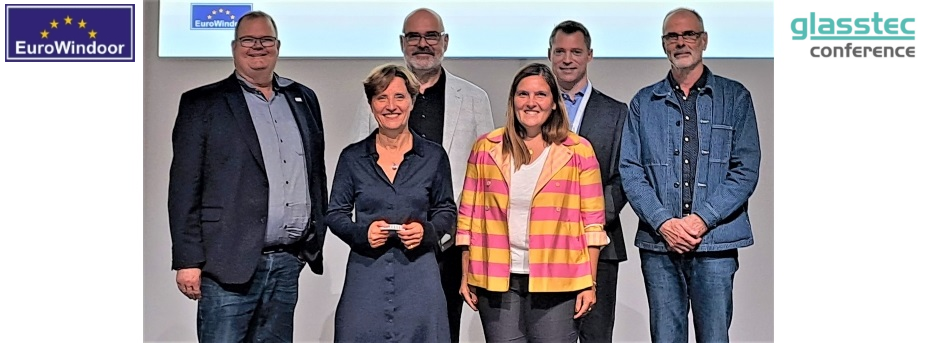
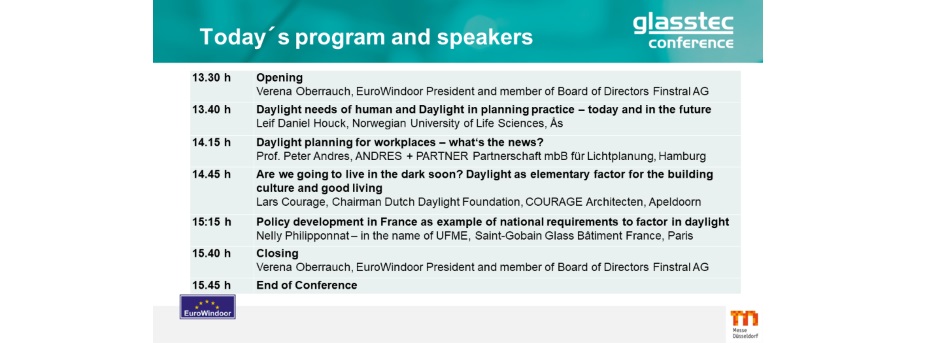
Ms Verena Oberrauch (EuroWindoor President and member of the Board of Directors of Finstral AG) moderated the conference and gave a short introduction underlining the importance of windows admitting daylight for healthier buildings. Mr Leif Daniel Houck from the Norwegian University of Life Science in Ås, Norway illustrated why human need daylight and how to start to take daylight into account when planning. Based on a study of various schools, he explained that 12 meters of facade per class should be set as a requirement.

Afterwards Mr Peter Andres from Beratende Ingenieure für Lichtplanung in Germany reported news of daylight planning for workplaces by showing practical examples. By allowing direct sunlight into living and working areas, people also experience the normal daily cycle indoors. He advocates an economical approach to lighting planning by first optimizing the use of daylight and then only adding artificial light to the required amount.

The chairman of the Dutch Daylight Foundation, Mr. Lars Courage from COURAGE Architecten asked the provocative question “Are we going to live in the dark soon?” But despite constant improvement in the quality of artificial light, he sees also in the future daylight as elementary factor for the building culture and good living. In the Dutch Daylight Award winning examples he emphasized the particularly good lighting by using daylight from above and explained the positive effects of daylight up to light-flooded prisons for a better penal system.

The conference was completed by Ms Nelly Philipponnat from Saint-Gobain Glass Bâtiment represening the Union des Fabricants de Menuiseries Extérieures (UFME) by giving a practical view on how policy developments are enacted with the example of France. The new regulation with requirements for minimum openings of habitable surface, daylight provision with a target Daylight factor and minimum view out in a space are trend-setting for the legislators of other countries.

After each speaker Ms Oberrauch summarized the key message and allowed participants to ask questions before she lead over to the next presentation.

EuroWindoor would like to thank our sponsors Aluplast GmbH, Finstral AG, Saint-Gobain Building Glass Deutschland and VELUX A/S to make the conference happen.

If you are interested in the presentations, you can download them here.

Press Contact:
Miriam Weppler
EuroWindoor General Secretariat
Walter-Kolb-Str. 1-7
60594 Frankfurt / Germany
Phone: +49 (69) 95 50 54 – 36
Fax: +49 (69) 95 50 54 – 11
Email: GS@EuroWindoor.eu

EuroWindoor looks back to a successful conference “Daylight by EuroWindoor” at glasstec 2022 Read More »

Join the conference “Daylight by EuroWindoor” from 13:30h to 16:00h online from the glasstec in Dusseldorf today

Dusseldorf, September 2022 – Today EuroWindoor will conduct its conference “Daylight by EuroWindoor” in hall 11 B24 at the glasstec fair in Dusseldorf. Established experts will inform about the newest developments, scientific findings and legislative examples of daylight in buildings.

To follow the live stream please register name and email address and login.

For the registration in English please click here.
For the registration in German please click here.
The conference begins at 13:30h and ends at 16:00h. As the conference will be translated simultaneously the stream will be available in English and in German language. The link to join the live stream will appear after registration and login at the conference program website for Wednesday:

For English language please click here
For German language please click here
Mr Houck (Norwegian University of Life Science) will explain the human need for daylight and will start on how to take daylight into account when planning. From this Mr Andres (Beratende Ingenieure für Lichtplanung) and Mr. Courage (Chairman Dutch Daylight Foundation, COURAGE Architecten) will deep dive into the planning aspect and construction phase. Lastly Ms Philipponnat (Saint-Gobain Glass Bâtiment) will show in the name of UFME a practical level how policy developments are enacted. After each panel there will be time for questions.

Ms. Oberrauch (EuroWindoor President and member of Board of Directors Finstral AG) will be moderating the conference.

EuroWindoor would like to thank our sponsors Aluplast GmbH, Finstral AG, Saint-Gobain Building Glass Deutschland and VELUX A/S to make the conference possible and helping to illustrate the importance of daylight in buildings.

Press Contact:
Miriam Weppler
EuroWindoor General Secretariat
Walter-Kolb-Str. 1-7
60594 Frankfurt / Germany
Phone: +49 (69) 95 50 54 – 36
Fax: +49 (69) 95 50 54 – 11
Email: GS@EuroWindoor.eu

Join the conference “Daylight by EuroWindoor” from 13:30h to 16:00h online from the glasstec in Dusseldorf today Read More »

The conference “Daylight by EuroWindoor” at the glasstec in Dusseldorf on 21st September 2022 will also be broadcast via free live stream

Frankfurt, September 2022 – Well-known experts will give an overview about the newest developments, scientific findings and legislative examples of daylight in buildings at the conference “Daylight by EuroWindoor” on 21st September. Those which are not able to come to hall 11 B24 of the glasstec fair in Dusseldorf can join the conference online!

Glasstec offers additionally a free live stream without the need of a fair ticket. All which is needed is to register name and email address and to login on the day of the conference. Then the link to the live stream on the conference page will become available. It is possible to register already now:

For the registration in English please click here.
For the registration in German please click here.
The conference begins at 13:30h and ends at 16:00h. As the conference will be translated simultaneously the stream will be available in English and in German language. The link to join the live stream will appear after registration and login on 21st September at the conference program website for Wednesday:

For English language please click here
For German language please click here
EuroWindoor would like to thank the sponsors Aluplast GmbH, Finstral AG, Saint-Gobain Building Glass Deutschland and VELUX A/S to make the conference happen and for helping to illustrate the importance of daylight in buildings.

Press Contact:
Miriam Weppler
EuroWindoor General Secretariat
Walter-Kolb-Str. 1-7
60594 Frankfurt / Germany
Phone: +49 (69) 95 50 54 – 36
Fax: +49 (69) 95 50 54 – 11
Email: GS@EuroWindoor.eu

The conference “Daylight by EuroWindoor” at the glasstec in Dusseldorf on 21st September 2022 will also be broadcast via free live stream Read More »

EuroWindoor welcomes you to the conference “Daylight by EuroWindoor” on the 21st September 2022 at the glasstec in Dusseldorf

Frankfurt, August 2022 – EuroWindoor is glad to invite to the conference “Daylight by EuroWindoor” at the glasstec fair in Dusseldorf. Well-known experts will lead the audience through the newest developments, scientific findings and legislative examples of daylight in buildings.

As a healthy indoor climate becomes more and more important during the planning and construction phase of a building, the use of daylight is getting more attention. This becomes even more important as many people were forced to stay indoor over the last two years with often insufficient air quality including daylight. Even on political level the topic has gotten momentum with the EPBD – for the first time – including indoor air quality as a parameter in construction.

The conference “Daylight by EuroWindoor” is showcasing for everyone interested on why daylight is even important. Mr Houck (Norwegian University of Life Science) will explain the human need for daylight and will start on how to take daylight into account when planning. From this Mr Andres (Beratende Ingenieure für Lichtplanung) and Mr. Courage (Chairman Dutch Daylight Foundation, COURAGE Architecten) will deep dive into the planning aspect and construction phase. Lastly Ms Philipponnat (Saint-Gobain Glass Bâtiment) will show in the name of UFME a practical level how policy developments are enacted. After each panel there will be time for questions.
Ms. Oberrauch (EuroWindoor President and member of Board of Directors Finstral AG) will be moderating the conference.

EuroWindoor would like to thanks our sponsors Aluplast GmbH, Finstral AG, Saint-Gobain Building Glass Deutschland and VELUX A/S to make the conference possible and helping to illustrate the importance of daylight in buildings.

If you would like to join the conference, please visit hall 11 B24. The conference begins at 13:30h and end at 16:00h.

For further information glasstec conference program please see:
https://www.glasstec-online.com/en/Program/glasstec_conference/Conference_programme

Press Contact:
Miriam Weppler
EuroWindoor General Secretariat
Walter-Kolb-Str. 1-7
60594 Frankfurt / Germany
Phone: +49 (69) 95 50 54 – 36
Fax: +49 (69) 95 50 54 – 11
Email: GS@EuroWindoor.eu

EuroWindoor welcomes you to the conference “Daylight by EuroWindoor” on the 21st September 2022 at the glasstec in Dusseldorf Read More »

Newsletter 08/2022

Start of the International Year of Glass 2022

As announced in May last year, the UN declared the year 2022 as the International Year of Glass (IYOG). With this, numerous events around the world will take place to celebrate all forms and aspects of glass.

Opening Ceremony of the International Year of Glass 2022

Under the title of “Celebrating the past, present and future of glass for a sustainable, equitable and better tomorrow!” the International Year of Glass 2022 (IOYG) began with the opening ceremony at the Palace of Nations in Geneva on February 10th. A chance for the glass industry to show the many advantages of windows in buildings.

More information

Newsletter 08/2022 Read More »

EuroWindoor feedback to the public consultation on derogation to the exclusion criteria for Propiconazole

Brussels 29 July 2022 – EuroWindoor replied to the ECHA consultation on derogation to the exclusion criteria for Propiconazole and strongly supports a renewal of the approval of Propiconazole in wood preservatives. The EuroWindoor feedback demonstrates with detailed explanation and justification that all 3 derogation criteria of the EU Biocidal Products Regulation (BPR) Article 5 2. are met for the active substance Propiconazole derogation criteria and should therefore be renewed.

Propiconazole is currently used as the main active substance in biocidal products for wood preservation of window and door frames due to its high efficacy spectrum, even at low concentration. Its unique efficacy against all main fungi makes it an essential component in the long lifespan of wooden windows and doors.

Looking at the strict criteria that the wooden window and door industry must observe in Europe, in particular the need for supplying Use Class 3 protection for most applications, a non-renewal of Propiconazole would de-facto leave the industry without any acceptable solution for wood preservation. Such a decision would have a disastrous impact on the building sector which should instead prepare its decarbonization by gradual increase of wood-based materials.

EuroWindoor therefore strongly support a renewal of the approval of Propiconazole based on its limited risk for human health and for the environment, for the unique benefits it brings to fight climate change thanks to the preservation of wood (and carbon storage) for a long period of time, and for complete absence of alternatives in European Member States which threatens the entire value chain of the wood industry.

For further information please see:

EuroWindoor feedback to the consultation on derogation to the exclusion criteria for Propiconazole (July 2022)

Press Contact:

Miriam Weppler
EuroWindoor General Secretariat
Walter-Kolb-Str. 1-7
60594 Frankfurt / Germany
Phone: +49 (69) 95 50 54 – 36
Fax: +49 (69) 95 50 54 – 11
Email: GS@EuroWindoor.eu

EuroWindoor feedback to the public consultation on derogation to the exclusion criteria for Propiconazole Read More »

EuroWindoor feedback to the public consultation on derogation to the exclusion criteria for Propiconazole (July 2022)

EuroWindoor represents the interest of window and door manufacturers all over Europe, including wooden products. In this regard, we have a comprehensive view of production processes and of the technologies available to protect wooden frames from biological attacks (blue stains, white rot, brown rot, insects).

Propiconazole is currently used as the main active substance in biocidal products for wood preservation of window and door frames due to its high efficacy spectrum, even at low concentration. Its unique efficacy against all main fungi makes it an essential component in the long lifespan of wooden windows and doors. Further evidence of the role of Propiconazole for the window and door industry can be found in the CEI-Bois – EuroWindoor – SBS joint position [1].

EuroWindoor believes Propiconazole meets the 3 derogation criteria simultaneously, as explained in the below statements.

1. Feedback on derogation of Article 5 2. (a), (b) and (c) of the BPR

(a) Risk from human, animal and environmental exposure to the active substance

Regarding the risk for human exposure

Risks for human health essentially occur at 3 different levels: risk for industrial workers (e.g. within impregnation plants), risk for professional workers/craftsmen (in workshops or on construction sites) and risk for end-users (during the lifetime of the treated product). Regarding the exposure risk for industrial workers, the industry already has in place a series of risk management measures: 1. All industrial impregnation processes used by the window and door industry are performed in closed loop systems (e.g. spray tunnels) or in dipping tanks where excess liquid is recycled. By design, these systems do not allow the spread of biocidal product containing Propiconazole into the rest of the plant, therefore protecting workers from direct exposure.  Any direct contact for workers is prevented by avoiding any spillover or splashing into other surfaces of the plant. 2. In order to ensure the use of proper Personal Protective Equipment (PPEs), the CLP regulation (Classification, Labelling and Packaging) sets requirements for all workers in charge of handling and maintenance operations. These are required to use PPEs as soon as they need to handle treated articles or to proceed to maintenance operations on the impregnation lines (especially hand and skin protection).  Workers in charge of maintenance and cleaning processes of wood impregnation installations must use adequate PPEs to limit the risk of skin or inhaling exposure. In addition, and as stated in the Biocidal Product Committee’s (BPC) opinion [2] on Propiconazole, “with regard to human health exposure, the risk related to primary exposure is considered acceptable with a conventional risk assessment (excluding ED properties) for industrial and professional users when appropriate personal protection equipment (PPE) are worn”. Regarding the exposure risk for professional workers and craftsmen: As for industrial use, the CLP regulation – via the mandatory publication of Safety Data Sheets (SDS) – requires producers of biocidal products to inform professional users about the appropriate equipment to wear while using a specific product. The use of PPEs therefore becomes mandatory for wood treatment applications (e.g. brushing) in accordance with relevant material safety data sheet.

EuroWindoor feedback to Consultation on derogation to the exclusion criteria for Propiconazole CZ

EuroWindoor feedback to the public consultation on derogation to the exclusion criteria for Propiconazole (July 2022) Read More »

EuroWindoor feedback on the proposal for a new regulation replacing the Construction Product Regulation

EuroWindoor submitted its feedback end of June on a new regulation replacing the Construction Product Regulation (CPR). The aim of the initiative of the European Commission is to improve the single market for construction products, promote growth and jobs in the sector as well as focus on the environmental goals set in the Green Deal. For EuroWindoor the CPR is very important as it has also far-reaching consequences for products in the window and façade sector.

EuroWindoor supports the overall aims that the proposal to replace the CPR tries to achieve, especially by setting a level playing field when putting the focus on the functioning of the market surveillance and of the Notified Bodies. However, the draft proposal itself has many issues. Structurally the draft is written too complicated with too many articles referencing to other articles, making reading the draft for experts already difficult let alone for manufacturers who have to implement those changes. As a result of this confusing structure the draft is difficult to understand and making many areas open for interpretation.

Besides the many unclear specifications in the articles etc. EuroWindoor strongly emphasises to be cautious of over-regulation, partly because of broadening the scope in certain parts of the draft. New areas in the draft are for example the inclusion of “workers, consumers and occupants” in the Annex, something that is already been regulated in other European legislation e.g. Framework Directive on Safety and Health at Work. For product information requirements lengthy lists of information are demanded, some of whom are confidential or critical and could lead to legal disputes in the long run.

EuroWindoor also like to remind that there are currently a number of other development and revisions going on concerning the construction sector like EED, EPBD and the new Ecodesign for Sustainable Products Regulation (ESPR), which was proposed at the same time as the new CPR. There needs to be a tight coordination and alignment between all those legislative initiatives to prevent from overlapping and overregulation.

EuroWindoor, as representatives of the window, door and façade sector, identified numerous other difficult parts in the Commission´s proposal like the new definitions for construction products – which now includes packaging -or product types multiplying the number of declarations and required product information from a manufacturer.

For further information please see:

EuroWindoor feedback on the proposal for a new regulation replacing the CPR (June 2022)

EuroWindoor feedback on the Ecodesign for Sustainable Product Regulation – ESPR (June 2022)

Press Contact:

Miriam Weppler
EuroWindoor General Secretariat
Walter-Kolb-Str. 1-7
60594 Frankfurt / Germany
Phone: +49 (69) 95 50 54 – 36
Fax: +49 (69) 95 50 54 – 11
Email: GS@EuroWindoor.eu

Picture from https://ec.europa.eu

EuroWindoor feedback on the proposal for a new regulation replacing the Construction Product Regulation Read More »

EuroWindoor feedback on the proposal for a new Ecodesign for Sustainable Products Regulation (ESPR)

The European Commission published a consultation on the Ecodesign for Sustainable Product Regulation addressing a broader spectrum of products with the aim to make the EU market more sustainable. The scope of ESPR includes all construction products and EuroWindoor gave feedback with the point of view of the fenestration sector.

The Commission proposal for new regulation replacing the Ecodesign Directive includes many positive changes which EuroWindoor supports. To reduce the negative life cycle environmental impacts of products the Environmental Sustainability addresses green transition of the manufacturing processes, overall sustainability of the built environment and efficient use of natural resources by facilitating reuse and recycling.

EuroWindoor supports the aim of the ESPR making sustainable products the norm while at the same time strengthening a level playing field with a fair and smooth functioning internal market. However, EuroWindoor stresses the importance of ensuring a close coordination and alignment between the ESPR and those other legislative initiatives under development/revision all affecting the building sector (e.g. CPR, EED, EPBD, …) to prevent from overlapping and overregulation. To avoid unnecessary costs and burdens associated with requirements on products and their value chain EuroWindoor underlines the importance of involving all relevant actors – including industry and Member States in the development and implementation of such product specific regulations.

EuroWindoor sees it very positive that requirements will continue to be set on a product-by-product basis taking into account individual specificities and characteristics of the different products. Especially windows are very complex and individual products therefore a differentiation on a product by product based on scientific assessment methods through recognised European and International standards is vital for a functioning market.
In contrast to this EuroWindoor does not support classes of performance labels (traffic light) on construction products as such a label could easily be misleading which is the same with benchmarking on simple environmental aspects such as recycled content. Only a single CE marking should be required for products giving the information on the performance of construction products.

For further information please see:

EuroWindoor feedback on the Ecodesign for Sustainable Product Regulation – ESPR (June 2022)

Press Contact:

Miriam Weppler
EuroWindoor General Secretariat
Walter-Kolb-Str. 1-7
60594 Frankfurt / Germany
Phone: +49 (69) 95 50 54 – 36
Fax: +49 (69) 95 50 54 – 11
Email: GS@EuroWindoor.eu

Picture from  European Economic and Social Committee

EuroWindoor feedback on the proposal for a new Ecodesign for Sustainable Products Regulation (ESPR) Read More »

EuroWindoor feedback on the proposal for a new regulation replacing the Construction Product Regulation

EuroWindoor feedback on the proposal for a new regulation replacing the Construction Product Regulation (June 2022)

EuroWindoor appreciate the opportunity to give feedback to the proposal from the European Commission for a new regulation laying down harmonised conditions for the marketing of construction products, amending Regulation (EU) 2019/1020 (market surveillance regulation) and repealing Regulation (EU) 305/2011 (CPR).

EuroWindoor is a firm supporter of the concept of the single European market for construction products and sees the EU Construction Products Regulation as the main instrument to obtain a well-functioning internal market.

1 General comment

EuroWindoor welcomes the outspoken aim to strengthen a smooth functioning of the single market for construction products based – as the main route – on harmonised standards as the instrument for technical language and harmonised assessment methods. We also support the increased focus on a level playing field, expressed among others through increased focus on the functioning of the market surveillance and of the Notified Bodies. The inclusion of sustainability is furthermore appreciated by EuroWindoor.

However, we also consider that many aspects of the draft CPR are too complicated and many areas are too open for interpretation. The complicated structure of the regulation and referencing between different articles make it difficult to read and understand, which may cause huge problems for implementation by manufacturers. This does to some extend make it difficult to give concrete input to all specific articles, as the consequence of them depends in a high degree on the practical implementation. Additionally there are numerous places where the Commission is empowered to develop delegated acts. EuroWindoor fully recognize that, if the Commission had this power under the current CPR, some of the identified problems could have been handled without starting a revision process. However, EuroWindoor believes this option to deliver delegated acts needs to be used with great care, as it does introduce a high degree of uncertainty and risk especially for the economic operators who will need to comply to an ever-changing rulese

EuroWindoor feedback on the proposal for a new regulation replacing the Construction Product Regulation – CZ

EuroWindoor feedback on the proposal for a new regulation replacing the Construction Product Regulation (June 2022) Read More »

Proposal for new regulation replacing the Ecodesign Directive (June 2022)

EuroWindoor feedback on the ESPR consultation

EuroWindoor appreciates the opportunity to give feedback to the proposal on Ecodesign for Sustainable Product Regulation (ESPR) from the European Commission.

EuroWindoor supports the aim of making sustainable products the norm while at the same time strengthening a level playing field with a fair and smooth functioning internal market. These are essential elements in achieving the EU’s objectives of climate neutrality and creating a circular economy. EuroWindoor also welcomes the changed focus of the scope to now include resource efficiency in a life cycle perspective alongside energy related aspects.

EuroWindoor would however like to stress the importance of ensuring a close coordination and alignment between the ESPR and those other legislative initiatives under development/revision all affecting the building sector. That being e.g. the Construction Product Regulation (CPR), the Energy Efficiency Directive (EED), the Energy Performance of Building Directive (EPBD) as well as the work on the Roadmap on whole life carbon emissions of buildings. A successful outcome will depend on the specific interaction between the legislations and on their ability to support and supplement each other whereas overlapping’s should be avoided. For example, should information requirements related to the Digital Product Passport (DPP) be connected to and aligned with other databases, e.g. the SCIP database to avoid uploading the same information in different ways.

It is very positive that requirements will continue to be set on a product-by-product basis taking into account individual specificities and characteristics of the different products. EuroWindoor would like to underline the importance of involving all relevant actors – including industry and Member States in the development and implementation of such product specific regulations so no deviations on methods to assess and verify product performance or how to deliver product information will appear. This to ensure that potential costs and burdens associated with requirements on products and their value chain, such as information requirements via a DPP will be proportional to the value a given information provides in relation to reducing negative environmental and climate impact. Close cooperation between the relevant actors will also help ensuring that conflicting requirements are not introduced. For example, some requirements may impact the safety or durability of products, or longer lasting designs may be more difficult to repair. Another example is that higher energy efficiency levels in some applications may lead to an increased need for materials, which means more resources and a larger environmental footprint. Furthermore the use of different materials in similar products (e.g. window framing made of PVC, metal or wood) will need different relevant Ecodesign requirements in the same product group.

It is fundamental that requirements will be based on scientific assessment methods through recognised European and International standards that are reliable and verifiable. For construction products this means specifically that it is essential to have continued focus on the assessment of the performance of construction products at building level due to the different construction traditions and climate conditions across EU, which implies a modular approach in the assessment of environmental performance from cradle to grave, as in EN 15804, and that performance requirements are based on national regulation. For the same reason EuroWindoor does not support classes of performance labels (traffic light) on construction products as a product itself may be environmentally superior but at the same time it may in the operation and building context be inferior – both in terms of environmental and technical performance. Such a label could therefore easily be misleading. Introducing benchmarking on simple environmental aspects such as recycled content or best technical properties is also not recommendable as it does not provide a comprehensive sustainability performance. Only a single CE marking should be required for products giving the information on the performance of construction products.

About EuroWindoor AISBL – EuroWindoor AISBL was founded as an international non-profit Association, in order to represent the interests of the European window, door and facade (curtain walling) sector. Our 19 national associations speak for European window, door and facade manufacturers that are in direct contact with consumers, and thereby having large insights on consumers’ demands and expectations. We are at the forefront interacting with dealers, installers and consumers buying windows and doors, and the companies behind the associations cover selling all over Europe.

EuroWindoor feedback on the ESPR consultation – CZ

Proposal for new regulation replacing the Ecodesign Directive (June 2022) Read More »

Online workshop on Sustainable Wood Protection & Availability of Essential Tools on 24th May 2022

EuroWindoor organised together with CEI-Bois and SBS an online workshop on Sustainable Wood Protection & Availability of Essential Tools – Perspective of end-users on the EU renewal of Propiconazole (PT-8) to raise awareness among the authorities on the pending renewal of propiconazole and the consequences of a ban for the woodworking industry. This is highly relevant for EuroWindoor as timber window and door frames would be affected by a ban as well.

The webinar will be on Tuesday, 24th May (15.00 – 17.00 CEST) to hear the views of technical institutes, universities, institutional experts & end-users to gain knowledge around the value chain of Propiconazole, within the broader context of a holistic and sustainable approach to European wood protection.

The webinar is going to give an overview on the importance of the European wood preservation segment towards reaching the goals set within the EU Sustainability Goals as well as giving an outline the value chain from the forest to the wood preservatives supplier.

During the webinar the results of 4 studies conducted in 9 EU countries in from 2020-2021 will be presented to show the lack of suitable alternatives.

Lastly the event will conclude with a round table addressing key complementary topical issues within the wood preservation segment and the position of Propiconazole. Participation is free of charge.

For more information view Save the Date flyer & Programme Overview.

For registration at the EPPA SA/NV consultancy please click here.

We look forward seeing you in the webinar!

For further information please see:

EuroWindoor answer to the public consultation on potential candidates for substitution of Propiconazole

The use of Propiconazole in wood preservatives for timber windows and doors

Press Contact:
Miriam Weppler
EuroWindoor General Secretariat
Walter-Kolb-Str. 1-7
60594 Frankfurt / Germany
Phone: +49 (69) 95 50 54 – 36
Fax: +49 (69) 95 50 54 – 11
Email: GS@EuroWindoor.eu

Online workshop on Sustainable Wood Protection & Availability of Essential Tools on 24th May 2022 Read More »

EuroWindoor answer to the public consultation on revision of RoHS Directive (May 2022)

Public Consultation on the Revision of Directive 2011/65/EU on restriction of the use of certain hazardous substances in electrical and electronic equipment (RoHS Directive)

Introduction

Context: Electrical and electronic equipment (EEE) is a highly diverse product group characterised by fast innovation cycles, which lead to continuous changes in equipment features, performance and materials used. EEE contains various hazardous substances, which could pose risks to the environment and human health during the EEE production and use, as well as during the collection, treatment and disposal of waste EEE (WEEE). The Circular Economy Action Plan (CEAP), which counts electronics as key product value chains, estimates that EEE is one of the fastest growing waste streams in the EU, with current annual growth rates of 2%. Directive 2011/65/EU (RoHS) currently restricts the use of ten hazardous substances in electrical and electronic equipment (EEE), in particular with regard to related waste management challenges, and related workers’ protection. By establishing mechanisms for restricting the use of such substances, the Directive aims to enable cleaner material cycles and environmentally sound treatment of waste EEE (WEEE), thus contributing to the circular economy and the protection of human health and the environment. It also aims to ensure the functioning of the Union market in a highly globalised sector, avoiding distortions of competition that might arise from differing product requirements. The Directive inspired similar laws in around 50 other jurisdictions around the world.
Purpose of the consultation: The European Commission is working on an impact assessment in support of a possible revision of the RoHS Directive. The purpose of this consultation is to collect information and views from stakeholders on how the RoHS Directive could be improved in order to maintain its relevance…

EuroWindoor answer to the public consultation on revision of RoHS Directive

EuroWindoor answer to the public consultation on revision of RoHS Directive (May 2022) Read More »

International Active House Symposium

After a long time of no physical meetings the Active House Alliance will have a Symposium on the 13th April in Rotterdam, organised by the Active House Alliance Netherlands. As a member of the Active House Alliance EuroWindoor is excited to see the return of face-to-face meetings.

The topic will be “How can we renovate in a circular and affordable manner with health, comfort and the resident in mind?”. The International Active House Symposium will demonstrate how to build affordable, healthy buildings focused on the resident. For EuroWindoor this is an important topic as it advocates to define and secure Healthy Indoor Climate in the legislative processes like the Energy Performance Directive of Buildings (EPBD), so people in the European Union live in healthy homes.

For property owners this event might be interesting to learn more about on how to provide a healthy, safe and future-proof neighbourhoods and residences. Visitors can learn about the importance of daylight in their homes. In addition to that the Active House Award winners will be announced and the revamped Active House Specification will be unveiled. A wide variety of topics will provide the frame of this event.

More than 100 guests are expected to attend. If you want to take the chance to learn more about the Active House Alliance or to network, consider visiting the eights international Active House Symposium on the 13th April 2022 at De Doelen, Rotterdam. For more information on where to purchase a ticket (online and for the physical meeting) please visit the website for the International Active House Symposium.

For further information please see:

Active House Alliance

EuroWindoor feedback on the proposal to recast the EPBD (March 2022)

Press Contact:
Miriam Weppler
EuroWindoor General Secretariat
Walter-Kolb-Str. 1-7
60594 Frankfurt / Germany
Phone: +49 (69) 95 50 54 – 36
Fax: +49 (69) 95 50 54 – 11
Email: GS@EuroWindoor.eu

International Active House Symposium Read More »

EU Restriction Procedure Lead in PVC

EU Restriction Procedure Lead in PVC (May 2022)

Currently, the restriction procedure for lead in PVC is intensively re-discussed at European level. Already at the end of 2015, the European PVC industry completely phased out the use of lead in virgin material as part of the voluntary commitment VinylPlus®. Especially against the background of increasing imports of PVC containing new lead (source: ECHA), the industry therefore, in principle, supports this restriction process strongly. However, for the purpose of an operational circular economy, the industry calls on the legislator to continue allowing established PVC recycling in precisely regulated exceptional cases. Thereby, lead that is already present in the EU market is handled in the best possible way being controlled in terms of health and the environment.
In current times of high energy prices, shortages of raw materials and the political drive for energy-efficient renovation of buildings, the industry has set itself the goal of using as much recycled PVC as possible in production – thereby strengthening the circular economy and reducing CO2 emissions.
Our request is set against the following background:
PVC building waste has already been recycled for more than 25 years. Today, mechanical recycling is well established and around 730,000 tons of PVC are recycled per year in Europe, of which more than …

Joint position EU Restriction Procedure Lead in PVC CZ – DE – FR – PL

EU Restriction Procedure Lead in PVC (May 2022) Read More »

EuroWindoor feedback on the proposal to recast the Energy Performance of Buildings Directive (EPBD)

Brussels 31 March 2022 – EuroWindoor gave feedback to the European Commission`s consultation on the proposal to recast of the Energy Performance of Buildings Directive (EPBD). EuroWindoor supports the movement from the EPBD to enable a green transition of the European building stock and support the creation of more sustainable and healthier living conditions for Europeans, but sees also room for improvement.

Broadening the scope of the EPBD and strengthened the role of public buildings are positive signals for the importance of renovating the building stock in reaching the climate target for 2030 and 2050. EuroWindoor supports the creation of new instruments to trigger the renovation of the worst performing buildings by introducing Mandatory Energy Performance Standards (MEPS). The improved reliability of Energy Performance Certificates (EPCs), their expanded scope as well as the shorter validity period will provide a better framework for monitoring and securing the achievement of the agreed energy saving targets.

The EPBD will lead to a legislative framework that will ensure investments that will lead to energy efficient, decarbonised and healthy building. For this a more holistic approach to buildings, i.e., moving beyond energy performance requirements, is needed. EuroWindoor therefore very much welcomes the new provisions in the EPBD revision to better factor in health, comfort and indoor air quality (IAQ) as well as the proposal to expand the scope by including a CO2 emission reduction dimension.

However, EuroWindoor sees the potential to improve the revision of the EPBD to deliver the full potential of the multiple benefits of energy efficiency.

For EuroWindoor the following four points are critical to improve on:

  1. Strengthening the new definition for zero-emission buildings
  2. Ensuring a Healthy Indoor Climate for all Europeans
  3. Factoring in the energy balance principle for window products
  4. Further boost the renovation wave as part of national building renovation plans and taking Energy Efficiency First principle into account for MEPS

For further information please see:

EuroWindoor feedback on the proposal to recast the EPBD (March 2022)

Press Contact:

Miriam Weppler
EuroWindoor General Secretariat
Walter-Kolb-Str. 1-7
60594 Frankfurt / Germany
Phone: +49 (69) 95 50 54 – 36
Fax: +49 (69) 95 50 54 – 11
Email: GS@EuroWindoor.eu

EuroWindoor feedback on the proposal to recast the Energy Performance of Buildings Directive (EPBD) Read More »

Feedback on the European Commission’s proposal to recast the EU Energy Performance of Buildings Directive (EPBD)

Feedback on the European Commission’s proposal to recast the EU Energy Performance of Buildings Directive (EPBD) (March 2022)

EuroWindoor welcomes the opportunity to provide feedback on the proposed revision of the Energy Performance of Buildings Directive (EPBD) in COM(2021)802final. We need an ambitious EPBD revision to enable the green transition of the European building stock and create more sustainable and healthier living conditions for all Europeans.

This will require a close alignment with the Energy Efficiency First Principle and other relevant files from the Fit for 55 Package, particularly the Energy Efficiency Directive (EED), the ETS for buildings, the Effort Sharing Regulation and the Renewable Energy Directive (RED).

The energy renovation of buildings is a key European flagship for national recovery plans with significant amounts being invested in buildings in the coming months and years, also as part of the Renovation Wave. We therefore support the broadened scope and strengthened exemplary role of public buildings, as well as the creation of new instruments to trigger the renovation of the worst performing buildings by introducing Mandatory Energy Performance Standards (MEPS).

The improved reliability of Energy Performance Certificates (EPCs), their expanded scope as well as the shorter validity period will provide a better framework for monitoring and securing the achievement of the agreed energy saving targets …

EuroWindoor feedback on the proposal to recast the EPBD – CZ

Feedback on the European Commission’s proposal to recast the EU Energy Performance of Buildings Directive (EPBD) (March 2022) Read More »

EuroWindoor gives feedback on the call for evidence to review the RoHS Directive

Brussels 11 March 2022 – EuroWindoor is glad to provide feedback during the call for evidence supporting the review of the use of certain hazardous substances in electrical and electronic equipment (RoHS) to simplify the current legislation, make it more efficient and coordinate it more with other legislative regulations like REACH.

EuroWindoor proposes for a recast of RoHS that electrical devices attached to windows, doors and facades shall be regulated by RoHS, but not the construction product itself which is covered sufficiently by CPR (2011/305/EU) and REACH (2006/1907/EC). That would lessen the administrative burdens and bring the consistency within the EU regulations.

Windows, doors and facades are normally assembled and installed by professionals and will stay in the building for 40+ years whereas an electrical device itself typically will be replaced 2 to 3 times during this period. This is partly due to shorter expected life time for these components but maybe more importantly due to high innovation rate in development of new and smarter solutions that can be an integrated part of smart buildings. EuroWindoor believes RoHS has for construction products no further added protection of humans and the environment beyond of what is already achieved through the Construction Product Regulation and REACH.

For further information please see:

EuroWindoor Feedback on the call for evidence to review the RoHS Directive (March 2022)

Press Contact:
Miriam Weppler
EuroWindoor General Secretariat
Walter-Kolb-Str. 1-7
60594 Frankfurt / Germany
Phone: +49 (69) 95 50 54 – 36
Fax: +49 (69) 95 50 54 – 11
Email: GS@EuroWindoor.eu

EuroWindoor gives feedback on the call for evidence to review the RoHS Directive Read More »

Feedback on the call for evidence to review the RoHS Directive

EuroWindoor Feedback on the call for evidence to review the RoHS Directive (March 2022)

EuroWindoor appreciates the opportunity to give feedback during the call for evidence supporting the review of Directive 2011/65/EU on the restriction of the use of certain hazardous substances in electrical and electronic equipment (RoHS)1. As mentioned in “the call for evidence” there is a range of issues with the practical operation of the Directive and the surrounding systems especially for construction products like windows, doors and facades with electrical devices in category 11 (“Other EEE not covered by any of the categories”).

Electrical devices attached to windows, doors and facades shall be regulated by RoHS, but not the construction product itself which is covered sufficiently by CPR (2011/305/EU) and REACH (2006/1907/EC).

EuroWindoor represent the interest of the European window, door and façade sector and has in this role previously provided input for studies and consultations related to RoHS (2011/65/EU). These products which are normally installed permanently in buildings by professionals have a long life time (40+ years) whereas the electrical device that might be fitted to it will have a much shorter life time (10-15 years). The electrical devices will therefore always be easily replaceable and by that possible to both buy and dispose separately …

EuroWindoor Feedback on the call for evidence to review the RoHS Directive – CZ

EuroWindoor Feedback on the call for evidence to review the RoHS Directive (March 2022) Read More »

Joint position on the proposal to recast the Energy Performance of Buildings Directive 2022

Brussels, 9 March 2022 – EuroWindoor along with other European Window Stakeholders published a joint position on the Commission proposal to recast of the Energy Performance of Buildings Directive (EPBD). As buildings account for 40% of energy consumption and 36% of CO2 emissions the European associations give important input and more insight into this issue.

ARGE, European Aluminium, EPPA, ES-SO, EuroWindoor and Glass for Europe are strong supporters of the EPBD, but see the need for improvement to achieve the European Union climate targets from the Paris agreement. An important point is the reduction of the buildings energy use by improving the building envelope first which goes along with the Energy Efficiency First Principle.

EuroWindoor and the other European Window Stakeholder see three key objectives to optimise the EPBD.

Firstly, supporting the window replacement rate to accelerate the Renovation Wave. Currently the renovation rate is stagnating around 1% which is especially problematic considering that more than half of Europe´s buildings are fitted with inefficient windows.
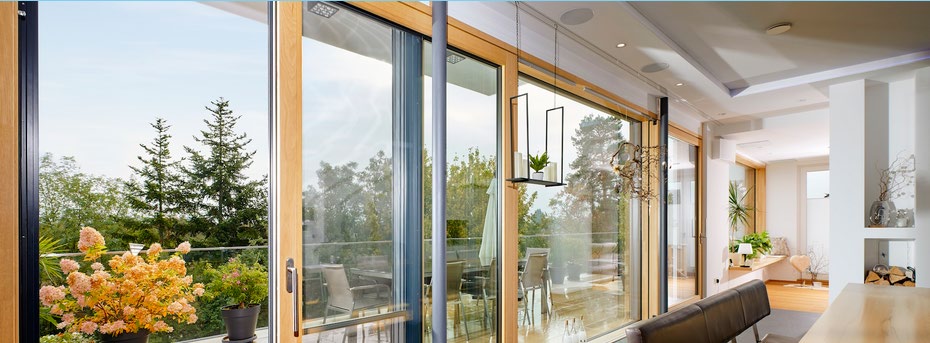
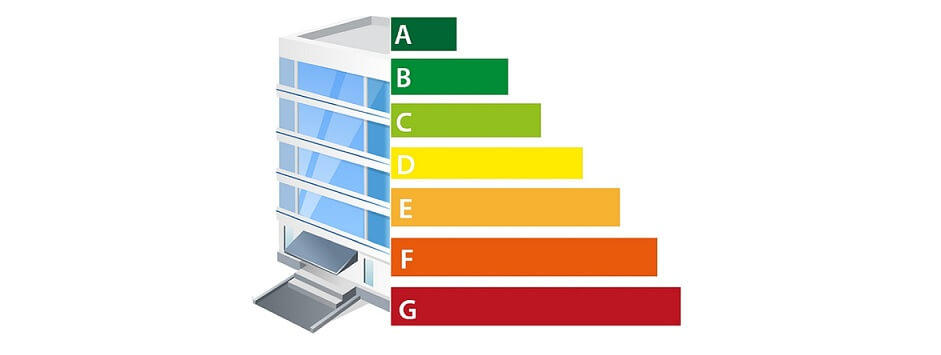
Secondly, using the “Energy Balance” approach to assess the energy performance of windows. The “Energy Balance” takes energy (heat) losses as well as energy gains (solar heat gains) into account when calculating the energy performance of a building or building element. This is in contrast to the currently used method of only relying on the thermal transmittance (U-Value). This is a one-sided approach and does not give an accurate picture of the energy performance of building elements like windows.

Thirdly, defining and securing Healthy Indoor Climate. As people in the European Union spent up to 90% in their homes it becomes more and more important to adverse effect on health, well-being and productivity. Therefore, EuroWindoor and the other European Window Stakeholders strongly support the introduction of an ambitious Healthy Indoor Climate definition with measurable parameters.

For further information please see:

Joint position on the proposal to recast the EPBD (March 2022)     
Joint position paper on the Renovation Wave (March 2021)

Press Contact:
Miriam Weppler
EuroWindoor General Secretariat
Walter-Kolb-Str. 1-7
60594 Frankfurt / Germany
Phone: +49 (69) 95 50 54 – 36
Fax: +49 (69) 95 50 54 – 11
Email: GS@EuroWindoor.eu

Joint position on the proposal to recast the Energy Performance of Buildings Directive 2022 Read More »

Energy Performance of Buildings Directive

Joint position on the proposal to recast the EPBD (March 2022)

The Energy Performance of Buildings Directive (EPBD) has contributed to improving the energy performance of European buildings and our associations ARGE, European Aluminium, EPPA, ES-SO, EuroWindoor and Glass for Europe are strong supporters of this framework.

Buildings account for about 40% of the energy consumption and 36% of CO2 emissions in the EU1. If Europe is to achieve its decarbonisation goals and contribute fully to the realization of the Paris agreement, a massive reduction of buildings’ energy needs is a necessity. This can only be achieved by starting to improve the energy performance of the building’s envelope in line with the Energy Efficiency First Principle. Only a building stock with a very low energy need could unleash the full carbon reduction potential of renewable energy generation…

Joint position on the proposal to recast the EPBD – CZ

Joint position on the proposal to recast the EPBD (March 2022) Read More »

Opening Ceremony of the International Year of Glass 2022

Under the title of “Celebrating the past, present and future of glass for a sustainable, equitable and better tomorrow!” the International Year of Glass 2022 (IOYG) began with the opening ceremony at the Palace of Nations in Geneva on February 10th. A chance for the glass industry to show the many advantages of windows in buildings.

Mrs. Alicia Durán, chair of the IOYG2022, opened the ceremony and welcomed the attendees to the “age of glass”. Invented by accident after a campfire on a beach by merchants, glass began its march across the world. Traded from Egypt to China, from Iran to Europe it is not possible to think about a world without glass.

The IYOG showcases the many ways glass can be used in improving our daily life but especially how glass can be used to reach the sustainability goals the United Nation and European Union have set for 2030. Here glass in buildings, foremost windows, is in the focus to help decarbonizing the building stock. This is needed as 40% of the CO2 emissions come from buildings. While some emissions are produced during the construction phase around 28% of the emissions are results from the day-to-day use of the building, mainly by heating and cooling systems.

In order to reduce the CO2, optimizing the building envelope should be the first priority along with the Energy Efficiency First Principle when planning or renovating a building. Glazed windows are a good way of reaching those goals resulting in a reduced needs for heating and cooling. Once installed windows do not produce more carbon emissions. Glass is non-toxic, up to 100% recyclable and when used in buildings as windows providing better health for occupants by giving daylight, natural ventilation and more. The latter aspects become increasingly important as people spent more and more time indoors and a healthy indoor climate is not a “comfort” aspect but necessary for the well-being of the occupants. EuroWindoor advocates for more sustainability in the building sector and healthier buildings for the people to live in and is excited for the IYOG2022 in hope to bring more awareness to these issues.

For further information please see:

International Year of Glass 2022      
EuroWindoor on benefits of windows and glazed areas

Press Contact:

Miriam Weppler
EuroWindoor General Secretariat
Walter-Kolb-Str. 1-7
60594 Frankfurt / Germany
Phone: +49 (69) 95 50 54 – 36
Fax: +49 (69) 95 50 54 – 11
Email: GS@EuroWindoor.eu

Opening Ceremony of the International Year of Glass 2022 Read More »

Start of the International Year of Glass 2022

As announced in May last year, the UN declared the year 2022 as the International Year of Glass (IYOG). With this, numerous events around the world will take place to celebrate all forms and aspects of glass.

Starting the celebrations will the opening ceremony from February 10th to 11th at the Palace of Nations in Geneva. Numerous internationally recognized speakers will attend as well as political figures and members of the glass sector. Additionally, the event will be streamed live via UN Web TV for those who are unable to attend the ceremony in person. The focus will be on the latest scientific and technical advancements of glass and on the historic and artistic significance.

Today, glass has become an integral part of our cityscapes and modern architecture is unimaginable without it. As a transparent building material, it is preferably used for windows. Glass enables solar gains to save heating energy and ensures healthy living by the use of daylight.

The opening ceremony will mark the beginning of fairs and events around the IYOG in 2022. From Italy to China, showcases around the world will display the vital role glass has in today’s society.

The Düsseldorf fair Glasstec, 20th-23rd September 2022, is a part of the IYOG as well. EuroWindoor is organizing the conference “Daylight by EuroWindoor” with renowned speakers during the Glasstec. Ending will the IYOG with a closing ceremony in Japan in December.

For further information please see the website of IYOG Opening Ceremony and Glasstec 2022.

Press Contact:

Miriam Weppler
EuroWindoor General Secretariat
Walter-Kolb-Str. 1-7
60594 Frankfurt / Germany
Phone: +49 (69) 95 50 54 – 36
Fax: +49 (69) 95 50 54 – 11
Email: GS@EuroWindoor.eu

Start of the International Year of Glass 2022 Read More »

EuroWindoor wishes Happy Holidays and looks back on an eventful year

As 2021 comes to an end EuroWindoor looks back on a dynamic year which proved to be very work loaded despite the ongoing Covid-situation. Nevertheless, we are happy about the successes that we have been able to record and that the importance of windows for energy efficiency and climate protection has moved more into focus.

A dominant topic this year, which will surely continue in 2022 as well, is the Fit-for-55 package. Many directives are currently under revision as a consequence to reach the ambitious climate targets for 2030 and 2050 set by the European Commission. EuroWindoor supports the climate targets and is therefore especially glad to have had a meeting with members of the European Commission to talk about the “Renovation Wave”. In the meeting EuroWindoor was able to show the importance of doubling and expanding the renovation wave as well as sector-specific-sub-targets.

The Energy Efficiency Directive is also a part of the Fit-for-55 package for which EuroWindoor just published its feedback on the proposal to recast the EED. Introducing the Energy Efficiency First principle and binding targets on EU level is strongly supported by EuroWindoor in order to reduce CO2 emissions. Nonetheless EuroWindoor still recommends setting binding targets on national level to make sure the climate targets are met.

2022 promises to be an eventful year as well. Soon the Commission proposal for the revision of the Energy Performance of Buildings Directive (EPBD) is expected to be published and will carry on into 2022. The EPBD is a very important topic for EuroWindoor as it is one of the main legislative acts to help reduce emissions and boost the renovation rate. In addition to that EuroWindoor is also anticipating the revision for the Construction Product Regulation (CPR) in 2022. EuroWindoor will keep going to publish position papers with further insight for the upcoming developments.

EuroWindoor wishes everyone happy Holidays and happy New Year!
We are wishing you holidays filled with fun and laughter, and very best wishes for a prosperous new year!

Hope to see you on the Fensterbau Frontale 2022 in Nuremberg.

Press Contact:
Miriam Weppler
EuroWindoor General Secretariat
Walter-Kolb-Str. 1-7
60594 Frankfurt / Germany
Phone: +49 (69) 95 50 54 – 36
Fax: +49 (69) 95 50 54 – 11
Email: GS@EuroWindoor.eu

EuroWindoor wishes Happy Holidays and looks back on an eventful year Read More »

Newsletter 12/2021

Overview on EuroWindoor’s activities

1. New Studies show no alternatives to propiconazole – CEI-Bois, EuroWindoor and SBS call for a renewal of the approval of propiconazole for use in wood preservatives for timber windows and doors
2. Meeting between the European Window Stakeholders and representative of the European Commission
3. Active House 10-year anniversary – a fruitful partnership with EuroWindoor
4. EuroWindoor feedback on the proposal to recast the Energy Efficiency Directive
5. EuroWindoor wishes Happy Holidays and looks back on an eventful year
6. Appointments 2022

New Studies show no alternatives to propiconazole – CEI-Bois, EuroWindoor and SBS call for a renewal of the approval of propiconazole for use in wood preservatives for timber windows and doors

Brussels, 1 September 2021 – CEI-Bois, EuroWindoor and Small Business Standards

(SBS) published an updated position paper including results of new studies scrutinizing for possible alternatives for propiconazole in wood preservatives for timber windows and
doors. The studies show no suitable biocidal alternatives for propiconazole for sustainable wood-based products in construction. Therefore, the three associations call for a renewal
of the approval of propiconazole and extend their invitation for a public-private partnership to develop long term sustainable alternatives.

More information

Newsletter 12/2021 Read More »

EuroWindoor feedback on the proposal to recast the Energy Efficiency Directive

Brussels, 19 November 2021 – EuroWindoor answered the public consultation of the European Commission on the proposal to recast the Energy Efficiency Directive (EED). The revision is needed to achieve the climate goals by 2030 and 2050 as the building sector is responsible for around 40% of energy consumption and 36% of the greenhouse gas emissions. Therefore, it is one of the most important points to decarbonize the building stock.

EuroWindoor, as representatives of the European window, door and façade sector, welcomes the revision of the EED and hopes to be able to provide further feedback. As part of the Green Deal the recast of the EED goes alongside with the revision of the EPBD for which EuroWindoor provided feedback as well. A close alignment between the EED and EPBD is especially important as they have massive implications for the building sector. Unclarities between them could be fatal.

The legal introduction of the Energy Efficiency First (EE1) Principle is an important step and highly anticipated by EuroWindoor. With the EE1 the decarbonization of the building sector goes further along as it helps taking account of cost-efficient energy efficiency measures. Further the European Commission extended the 3% minimum renovation obligation for Member States to meet NZEB standards to all buildings owned by public authorities. This is a strong sign and catalyst for local authorities to follow.

EuroWindoor fully supports the binding targets of 39%-41% reduction of primary energy consumption at EU level by 2030 but strongly recommends that the Member States should set national targets and make specific plans e.g., sector-specific targets.

For further details and aspects please see the EuroWindoor feedback:

EuroWindoor feedback on the proposal to recast the EU Energy Efficiency Directive (EED) (November 2021)

EuroWindoor answer to the consultation on the revision of the EPBD (June 2021)

[Here  you will find all position papers / publications]

EuroWindoor feedback on the proposal to recast the Energy Efficiency Directive Read More »

Active House 10-year anniversary – a fruitful partnership with EuroWindoor

Frankfurt, 21. October 2021- Comfort, energy and environment – those are the elements of the holistic approach the members of the Active House Alliance are striving for when designing buildings. This strategy was and still is revolutionary and slowly becomes a standard in many countries around the world. EuroWindoor is glad to be a supporter of this vision for many years and helps to implement these elements during the political decision-making process.

Mr. Hauk, Vice-President EuroWindoor and member of the Board of Directors of Active House Alliance, looks back on 10 years Active House: “Against all odds and many astonishing reactions to the idea of Active House many international alliances were founded to bring the people in the centre of attention when designing sustainable buildings.” 10 years ago the focus was on energy efficiency, so comfort aspects, like daylight, or even environmental aspects were not as important. Many people did not believe that it was possible to combine comfort aspects, sustainability and energy efficiency into one building. The Active House Alliance proved them otherwise and continues to do so all over the world.  Alliances from Canada, to Germany, Ukraine and China have been founded. This year Alliances in Bulgaria and USA have been founded as well.

One of the biggest accomplishes is the implementation of comfort aspects in the newly revised Energy Efficiency Directive of the European Commission. Currently the directive is still in the revision process, but EuroWindoor is monitoring it closely and encourages the political decision makers to focus more on the importance of indoor climate.
Covid-19 forces many people to stay more indoors which brought comfort aspects more to the attention of politicians. This topic became very important as many governments began to acknowledge the significance of daylight, natural ventilation etc. to keep buildings occupants healthy.

A topic that is very important to the Active House approach and EuroWindoor is the realistic use of energy by the occupants to measure energy efficiency. Often times model numbers are used when calculating the energy efficiency of buildings. Those results are off as soon as the occupants behave differently from the model. The Active House Alliance and EuroWindoor are aware of this problem and constantly measures the energy efficiency of their buildings after people start using or living in the buildings. This shows everyone involved in the creation of the building were to mend the architect of the building and helps to improve future projects.

Press Contact:
Miriam Weppler
EuroWindoor General Secretariat
Walter-Kolb-Str. 1-7
60594 Frankfurt / Germany
Phone: +49 (69) 95 50 54 – 36
Fax: +49 (69) 95 50 54 – 11

Active House 10-year anniversary – a fruitful partnership with EuroWindoor Read More »

Scroll to Top